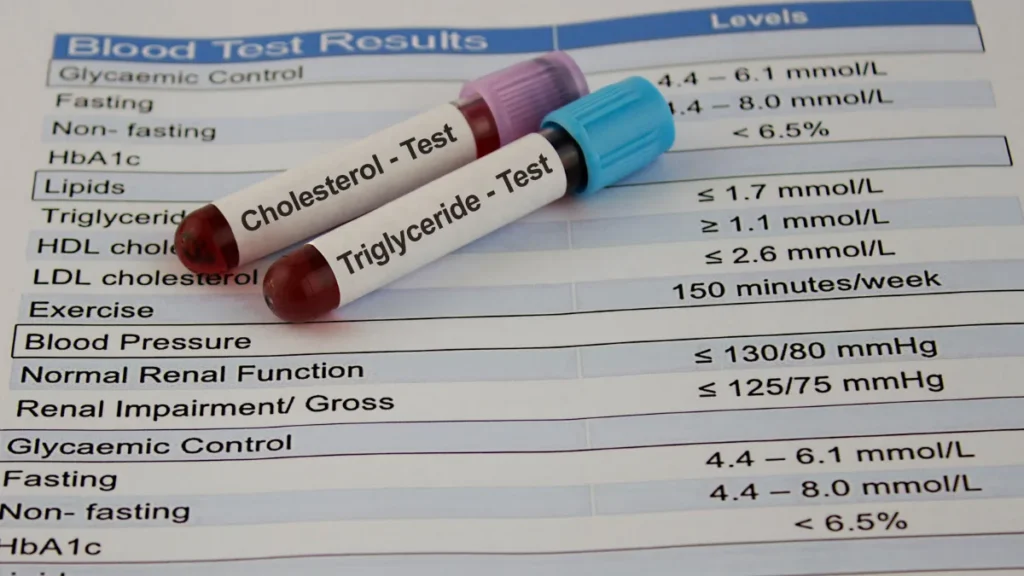
- A standard cholesterol test, often called a lipid profile, measures several different fats in the blood. LDL cholesterol is the number most closely linked to heart attack and stroke risk.
- There is no single “normal” LDL level that suits everyone. The goal depends on each person’s overall cardiovascular risk, and a result flagged as normal on a lab report may still be above the goal for someone with heart disease.
- Results are reported in one of two units depending on the country and laboratory: millimoles per litre (mmol/L) or milligrams per decilitre (mg/dL). The same result looks very different in each.
- Lipoprotein(a) is the exception. Its two units, mg/dL and nmol/L, cannot be converted reliably, so the result is best read in the unit the laboratory used.
- For most routine tests, fasting beforehand is not required.
A cholesterol result often arrives as a column of numbers, a few abbreviations, and perhaps an asterisk. What it rarely includes is an explanation. One figure may be flagged high, another low, and it is not always clear which matter most.
This guide explains what each part of a standard cholesterol test measures, how the two international units work, and why the right number for one person can be quite different from the right number for another.
Why Cholesterol Matters
Cholesterol is a waxy fat the body needs to build cells and make hormones. It travels in the blood inside particles called lipoproteins. Some of these particles can lodge in artery walls, where they build up over many years into the fatty plaque of atherosclerosis.
That plaque narrows arteries and can rupture, triggering a heart attack or stroke. The more of these particles in the blood, and the longer they are there, the greater the build-up. This is why cholesterol testing sits at the centre of heart disease prevention.
What a Cholesterol Test Measures
A standard lipid profile usually reports four or five values. Some laboratories add others, such as lipoprotein(a) or apolipoprotein B, when requested.
LDL cholesterol
LDL (low-density lipoprotein) cholesterol is the most important number on the report. Large genetic studies and clinical trials consistently show that lower LDL levels mean less plaque and fewer heart attacks and strokes. Most treatment decisions are built around it.
In many laboratories LDL is calculated from the other values rather than measured directly. The calculation is less accurate when triglycerides are very high or LDL is very low, which is why some laboratories measure it directly in those situations.
HDL cholesterol
HDL (high-density lipoprotein) cholesterol helps carry cholesterol away from artery walls. Low HDL levels are linked to higher cardiovascular risk. However, medicines that raise HDL have not, on their own, been shown to reduce heart attacks in trials, and HDL is not a treatment goal in major guidelines.
Triglycerides
Triglycerides are the body’s main store of fat. Levels are influenced by diet, alcohol, body weight, diabetes, and some medicines. Raised triglycerides add to cardiovascular risk, and very high levels can also inflame the pancreas.
Non-HDL cholesterol
Non-HDL cholesterol is total cholesterol minus HDL. It captures every type of particle that can contribute to plaque, not only LDL. Both European and American guidelines use it as a secondary goal, particularly for people with raised triglycerides or diabetes.
Two Units, One Result
Cholesterol results are reported in one of two units, depending on the country and the laboratory. Much of the world, including the UK, Canada, Australia, and New Zealand, uses millimoles per litre (mmol/L). The United States and a number of other countries use milligrams per decilitre (mg/dL).
The same blood sample gives very different-looking numbers in each unit. An LDL of 2.6 mmol/L is the same as 100 mg/dL. Knowing which unit a report uses is the first step in making sense of it, and the unit is usually printed beside each value.
For cholesterol values (total, LDL, HDL, and non-HDL), a result in mmol/L multiplied by about 38.7 gives the value in mg/dL. Triglycerides use a different factor, about 88.6, because they are a different molecule. Throughout this article, mmol/L is given first, with mg/dL in brackets.
Lipoprotein(a) is the exception
Lipoprotein(a), often written Lp(a), is reported either in mg/dL or in nanomoles per litre (nmol/L). Unlike cholesterol, there is no reliable way to convert between these units, because Lp(a) particles vary in size from person to person.
The guidelines themselves show the difficulty. European guidelines treat an Lp(a) above 50 mg/dL (105 nmol/L) as a risk-enhancing factor, while American guidelines treat 50 mg/dL (125 nmol/L) as the equivalent threshold. An Lp(a) result is therefore best read in the unit the laboratory reported, without converting it.
Why There Is No Single “Normal” Number
Laboratory reports usually print a reference range beside each result. This range describes typical values in the general population. It does not describe the right level for any particular person.
Guidelines set LDL goals according to overall cardiovascular risk. That risk takes into account age, blood pressure, smoking, diabetes, kidney function, family history, and whether heart or artery disease is already present. The higher the risk, the lower the LDL goal.
This is why an LDL of 2.5 mmol/L (97 mg/dL) might be flagged as normal on a report, yet sit well above the goal for someone who has had a heart attack. The table below shows the goals used in European guidelines. American guidelines use closely matching goals for most risk groups.
| Risk Level | LDL Goal (mmol/L) | LDL Goal (mg/dL) |
|---|---|---|
| Very high | Below 1.4 | Below 55 |
| High | Below 1.8 | Below 70 |
| Moderate | Below 2.6 | Below 100 |
| Low | Below 3.0 | Below 116 |
Most people who have had a heart attack, a stent, or a stroke fall into the very high risk group. European guidelines also recommend that people in the high and very high risk groups reduce their LDL by at least half from their starting level. Which risk group applies to an individual, and what their goal should be, is a judgement for their own doctor.
Preparing for the Test
For most routine cholesterol tests, fasting is not required. A meal before the test has only a small effect on most values, although triglycerides rise a little after eating. A fasting sample is sometimes requested when triglycerides are high or when an earlier result needs checking.
Cholesterol levels also vary naturally from one test to the next. An illness in the weeks before the test, a significant change in diet, or a change in medicines can all shift results. For this reason, doctors usually look at the trend across several tests rather than reacting to a single figure.
What Happens After the Result
When LDL is above a person’s goal, the first step is usually a look at overall risk and lifestyle. Diet plays a real but often modest role. Eating patterns rich in unsaturated fats and fibre help, and some foods affect blood cholesterol less than commonly assumed, as the evidence on eggs and cholesterol shows.
Where medicines are needed, statins are the foundation of treatment. Ezetimibe is commonly added when a statin alone does not reach the goal, and PCSK9 inhibitors are an option for people at the highest risk. A repeat test after starting or changing treatment shows how well it is working.
A cholesterol result means little on its own. It becomes meaningful when read alongside a person’s overall risk.
Conclusion
A cholesterol test is one of the most useful blood tests in heart health, but the numbers only make sense in context. LDL cholesterol matters most, the unit on the report changes how every figure looks, and the right goal depends on each person’s overall risk rather than a single normal range.
For anyone unsure what their own results mean, the report is worth discussing with their doctor or cardiologist, ideally alongside their other risk factors. That conversation turns a column of numbers into a plan.
Related Reading
- Understanding Your Cardiovascular Risk Factors
- The Mediterranean Diet and Your Heart
- Phytosterols: Nature’s Cholesterol Fighters
- Dietary Fibre and Your Heart: Why This Nutrient Deserves More Attention
- The hs-CRP Test: Inflammation, Heart Risk, and Why Context Matters
- Heart Health in Asian Populations