





- Receiving an ECG report that mentions “possible old heart attack” or “cannot exclude prior infarction” is one of the most anxiety-provoking findings in cardiology, and in an otherwise fit, healthy person with no symptoms, it is almost always a normal variant that requires no treatment.
- An ECG records the heart’s electrical activity from 12 different viewpoints around the chest and limbs. A Q wave is simply a small downward dip seen in some of these viewpoints. In certain positions, particularly one called lead III, a Q wave is extremely common in completely normal, healthy hearts.
- Automated ECG software flags Q waves as “possible old heart attack” because it cannot apply clinical judgement. A cardiologist reviewing the same ECG in the context of a fit, symptom-free person will almost always reach a very different and reassuring conclusion.
- A Q wave that genuinely indicates a previous heart attack must appear in multiple neighbouring viewpoints simultaneously and be accompanied by other supporting changes on the ECG. An isolated Q wave in a single viewpoint, with everything else completely normal, does not meet this standard.
- If you have received a report like this and are anxious, that anxiety is entirely understandable. A clinical review with a cardiologist resolves this question quickly and in most cases definitively.
One of the most common referrals I receive, easily once or twice a week, is a fit, healthy, often younger person who has had an ECG for a routine reason and whose report has come back with a phrase like “possible old heart attack,” “Q waves, cannot exclude prior infarction,” or “inferior changes, clinical review advised.”
They arrive in my clinic worried. Some have been unable to sleep. Some have told their families. Some have already started researching heart attack symptoms they have never had. The phrase “old heart attack” in a document about their heart has landed with enormous weight.
In the overwhelming majority of these cases, when I look at the ECG myself, the finding is a small, isolated Q wave in a single ECG viewpoint, a completely normal variant with no clinical significance whatsoever, that tells me nothing concerning about the health of this person’s heart or coronary arteries.
This article exists to explain why, and to give people the information they need before that anxious wait even begins.
Understanding the ECG, a Brief Explanation
What an ECG actually records
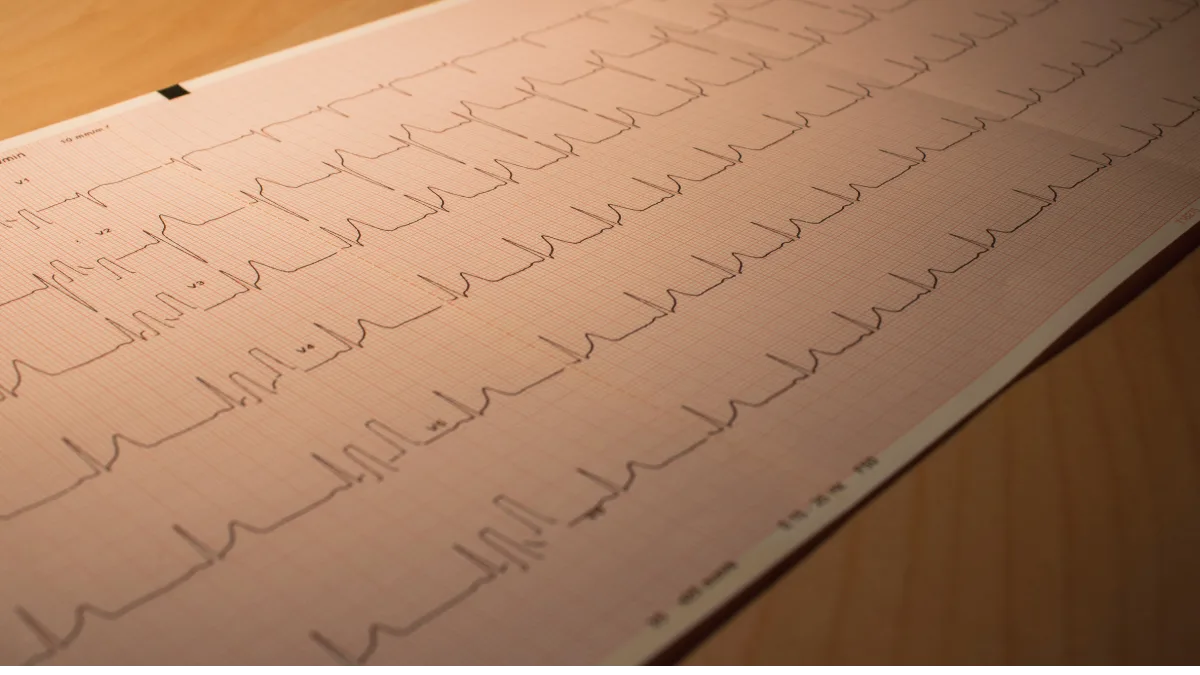
An electrocardiogram records the electrical activity of the heart using electrodes placed on the chest, arms, and legs. It does not take a picture of the heart. It records the tiny electrical signals that travel through the heart muscle with each beat, triggering the muscle to contract.
Because the electrodes are placed at different positions around the body, the ECG effectively looks at the heart’s electrical activity from 12 different angles, called leads or viewpoints. Each produces its own waveform on the paper trace, and together they give a detailed picture of how electrical signals are moving through the heart.
What a Q wave is
Each heartbeat produces a characteristic shape on the ECG trace, a series of peaks and dips. A Q wave is simply a small downward dip at the beginning of the main electrical spike of each beat. In many of the 12 viewpoints, small Q waves are entirely normal, they reflect the normal direction in which the electrical signal travels through the heart at the start of each beat.
In certain viewpoints, particularly one called lead III, which looks at the heart from a specific angle determined by the position of the left arm and left leg electrodes, a Q wave is especially common as a normal finding. It can appear and disappear simply with a change in body position or a deep breath. It is not a sign of damage. It is a reflection of the angle at which that particular viewpoint happens to be looking at the heart.
What Would a Genuine Concern Actually Look Like?
When a heart attack damages an area of heart muscle permanently, that area becomes electrically silent, it no longer generates the normal electrical signals. The ECG viewpoints looking directly at that damaged area will show an abnormal Q wave as a result, deeper, broader, and more prominent than a normal variant Q wave.
But, and this is the critical point, a heart attack affecting any meaningful area of muscle will show these changes across multiple neighbouring ECG viewpoints simultaneously, not in just one. It will also typically be accompanied by other supporting changes in the same viewpoints, changes in the shape of the waveform, and changes in the pattern of recovery between beats.
An isolated Q wave appearing in just one viewpoint, with every other viewpoint completely normal and no supporting changes anywhere on the trace, does not fit this picture at all. It is simply not how genuine heart attack scarring presents on an ECG. The same principle applies to other findings that sound alarming in isolation, such as a first-degree AV block, where context determines everything.
Why the Software Gets It Wrong
Modern ECG machines include automated interpretation software that analyses the trace and generates a written report. This software is useful, it can reliably identify certain patterns and flag them for clinical review. But it has an important limitation: it cannot think clinically.
When the software sees a Q wave in a particular viewpoint, it flags “possible old heart attack, clinical correlation recommended.” It cannot consider that the person is 32 years old and plays sport twice a week. It cannot consider that the Q wave is tiny and only visible in one viewpoint. It cannot consider that the person has never had any cardiac symptom in their life. It simply matches the pattern and generates the flag.
That flag is not a diagnosis. It is a prompt for a clinician to look at the full picture, and when a clinician does, the picture is almost always entirely reassuring.
In most of these referrals, one look at the ECG in the context of the patient in front of me resolves the question immediately. The report did its job. The clinical review does the rest.
Prof. Peter Barlis, Interventional Cardiologist
Normal Variant vs Genuine Concern, Plain Language Guide
| Feature | Almost certainly a normal variant | Worth investigating further |
|---|---|---|
| How many viewpoints show the Q wave | Only one viewpoint on the entire ECG | Multiple neighbouring viewpoints showing the same change |
| The rest of the ECG | Completely normal in every other respect | Other changes present in the same viewpoints |
| The person’s history | No cardiac symptoms ever, no risk factors, fit and active | History of chest pain, breathlessness, or cardiovascular risk factors |
| Does it change with breathing | Q wave reduces or disappears with a deep breath | Persistent regardless of position or breathing |
| Why the ECG was done | Routine, pre-employment, or incidental finding | ECG done because of symptoms or known cardiac history |
| Echocardiogram result | Normal heart structure and function throughout | Abnormal muscle movement in the area the Q wave viewpoints correspond to |
What Investigation Is Actually Needed?
A clinical review, not a cascade of tests
The appropriate response to a report like this in an otherwise healthy person is a clinical review with a cardiologist, not an immediate referral for a stress test, a CT scan of the coronary arteries, or a coronary angiogram. A cardiologist looking at the trace alongside your history and examination can in most cases answer the question definitively without any further testing at all.
If any uncertainty remains after that review, perhaps because there are some cardiovascular risk factors present, or because the ECG changes are borderline, an echocardiogram is the most efficient next step. This is an ultrasound of the heart that shows how the heart muscle is moving. If the muscle in the area corresponding to the Q wave viewpoint is moving completely normally, which it almost always is in these situations, that is powerful additional reassurance that no significant heart attack has occurred.
What you do not need
A fit, active, symptom-free person with no cardiovascular risk factors whose ECG shows an isolated Q wave in a single viewpoint, with everything else normal, does not need urgent investigation. There is no reason to stop exercising while waiting for a result. What is needed is a clinical review that puts the automated report in its proper context, and in most cases that conversation is the only investigation required.
What Is Worth Holding Onto
An automated ECG report is generated by software, not by a cardiologist. Its job is to flag things for clinical review, not to make diagnoses, and it has no way of knowing anything about the person attached to the trace.
A Q wave appearing in just one viewpoint, with everything else completely normal, is almost always a normal finding in a healthy heart. The pattern that genuinely indicates a previous heart attack appears across multiple neighbouring viewpoints at once, never in isolation.
A cardiologist reviewing the ECG alongside your history will in most cases give a clear and reassuring answer without further testing. Where any doubt remains, an echocardiogram provides the most direct additional reassurance.
Heart Matters Resource
When in Doubt, Get Checked Out
Where an ECG report mentions Q waves or a possible old heart attack, a cardiology review normally answers the question efficiently and very reassuringly. That anxiety is worth resolving properly rather than carrying it.
Conclusion
The automated ECG report that says “possible old heart attack” is one of the most anxiety-generating phrases in cardiology, and in a fit, healthy, symptom-free person it is almost always an over-call by software that cannot apply clinical judgement. The Q wave it has flagged is real. The interpretation it has placed on that finding is almost certainly wrong in this context.
A Q wave appearing in just one ECG viewpoint, with no other changes anywhere on the trace, in a person who has never had cardiac symptoms and has no significant risk factors, is a normal finding. It does not mean your heart is damaged. It does not mean you have had a heart attack. And it does not mean you need urgent investigation.
What it means is that you need a cardiologist to look at your ECG and your history together, and give you the reassurance that the software, by its nature, simply cannot provide.
Related Reading
- The Electrocardiogram (ECG): What It Is and What It Shows
- First-Degree AV Block on Your ECG: What Does It Really Mean?
- What Does a Left Bundle Branch Block (LBBB) Mean on an ECG?
- Right Bundle Branch Block (RBBB): Why It Sounds Worse Than It Usually Is
- Ventricular Ectopic Beats: What They Are and What They Mean
- The Echocardiogram: What It Shows and Why It Matters
- Chest Pain: Causes, Symptoms, and When to Seek Help