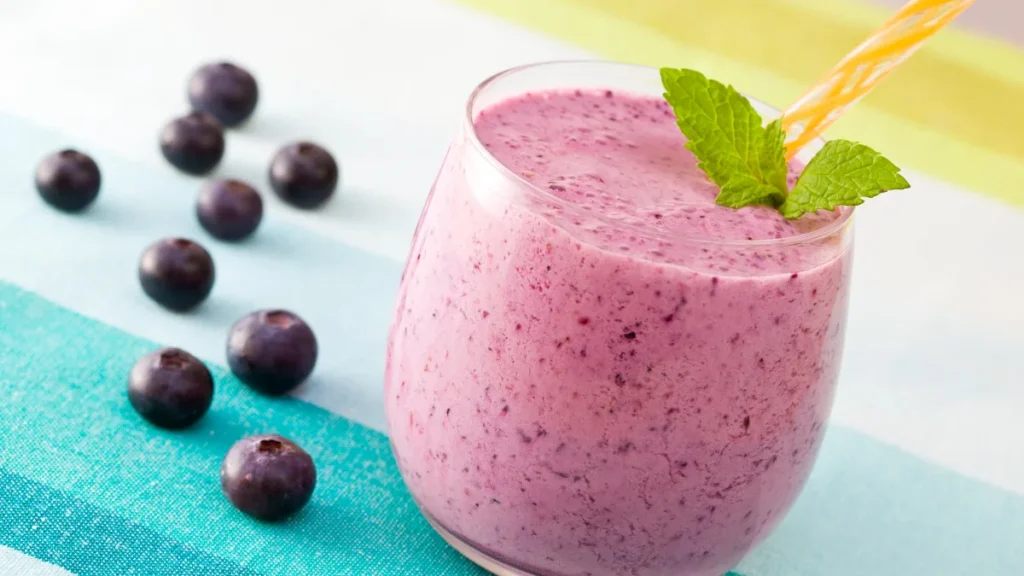
- A breakfast built around protein and soluble fibre tends to blunt the mid-morning energy dip that a carbohydrate-heavy breakfast often produces.
- Rolled oats and psyllium husk are two of the most concentrated everyday sources of soluble fibre, the type most consistently linked to lower LDL cholesterol.
- Blueberries supply anthocyanins, plant compounds associated with reduced inflammation and better blood vessel function in a growing body of research.
- Psyllium absorbs several times its own weight in water, which is why it is normally taken with plenty of fluid and built up gradually rather than started at a high dose.
- This is a full meal rather than a drink alongside one, and the quantities scale down easily for a smaller appetite.
Breakfast is the meal patients raise most often in clinic, and the question is almost always the same. What is quick, genuinely filling, and does not leave you hunting for something sweet by half past ten? The rushed default, toast or cereal eaten standing up, is mostly fast-releasing carbohydrate with very little protein or fibre attached to it.
This smoothie is the one that gets recommended most often, and the one made in this kitchen on ordinary weekday mornings. It takes about 10 minutes, most of which is finding the blender lid, and it holds hunger off through a long morning.
Why Breakfast Is Worth Getting Right
The value of a breakfast like this is not a single remarkable ingredient. It is that it changes the shape of the morning. A breakfast dominated by refined carbohydrate is absorbed quickly. Blood glucose rises, insulin follows, and for many people the result is a dip an hour or two later that feels a lot like hunger. Protein and soluble fibre both slow gastric emptying, which flattens that curve. The consequence is not dramatic, but it is real: fewer people reach for a second breakfast.
Breakfast is also the easiest meal to make consistent. Lunch and dinner vary with work and travel, while breakfast tends to be the same thing most days, which makes it the meal where a small improvement compounds most reliably.
The Thinking Behind the Ingredients
Every ingredient is doing a specific job. Oats and psyllium supply viscous fibre. Blueberries supply polyphenols and most of the sweetness. Egg whites and protein powder do the heavy lifting on protein and satiety. Chia is there largely for texture, swelling into a gel within minutes that gives the drink body rather than leaving it a thin shake, and carrying a plant-based omega-3 with it. The milk makes it blend, though the choice of milk matters more than it looks. Cinnamon is a finishing touch.
Ingredients
- 200 ml pasteurised egg whites
- 20 g rolled oats [notes: increase to 40g for a larger serve]
- 1.5 scoops vanilla protein powder [notes: whey isolate or plant-based both work well]
- 100 g frozen blueberries
- 200 ml unsweetened milk [notes: dairy or plant-based; sterol-enriched varieties are widely sold]
- 2 teaspoons chia seeds [notes: about 8g; a full tablespoon makes a thicker spoonable version]
- 3-5 g psyllium husk [notes: start at the lower end and build up gradually]
- 1/2 teaspoon Ceylon cinnamon
- A few ice cubes [notes: optional]
Instructions
- Add all ingredients to a blender: egg whites, oats, protein powder,
- blueberries, milk, chia seeds, psyllium husk, and cinnamon.
- Taste and adjust. A small drizzle of honey can be added if a little
- more sweetness is preferred.
Notes
| Nutrient | Approximate Amount |
|---|---|
| Energy | ~530 kcal |
| Protein | ~70g |
| Carbohydrates | ~47g |
| Dietary fibre | ~12g |
| Fat | ~10g (predominantly unsaturated) |
| Sugars | ~10g (from blueberries) |
What the Evidence Says About the Main Ingredients
Some of the ingredients below rest on large, consistent trial evidence. Others rest on smaller studies and reasonable mechanism. It is worth being clear about which is which.
Rolled oats
Among the richest food sources of beta-glucan, a soluble fibre repeatedly shown in trials to lower LDL cholesterol. Also a slow-release carbohydrate, which supports steadier energy.
Blueberries
Rich in anthocyanins, the pigments that give the fruit its colour. Studies associate them with reduced inflammation and improved blood vessel function, though the effect sizes are modest.
Psyllium husk
A concentrated viscous fibre, and one of the components used in cholesterol-lowering dietary patterns. It binds bile acids in the gut and needs generous fluid to work as intended.
Chia seeds
Swell into a gel within minutes, which is what gives the smoothie its thickness. They also supply alpha-linolenic acid, a plant-based omega-3 that complements oily fish rather than replacing it.
Ceylon cinnamon
Some studies link it with small improvements in blood sugar regulation, but the evidence is still developing and inconsistent. Here it is mainly there for flavour.
Protein content
Supports satiety and muscle maintenance. Preserving muscle mass matters increasingly with age, and is closely tied to metabolic and cardiovascular health.
The strongest evidence in that list sits with the soluble fibre. Decades of trials support the link between beta-glucan from oats and lower cholesterol, and the same broad picture holds across dietary fibre more generally. The evidence for cinnamon and blood sugar is considerably thinner, and it belongs in the recipe as a flavour rather than as a treatment. Plant-based omega-3 from seeds sits somewhere in between.
How the Cholesterol Ingredients Add Up
Three ingredients here act on cholesterol, and the reason they are worth having together is that they work by different routes. Viscous fibres such as the beta-glucan in oats and the mucilage in psyllium bind bile acids in the gut, which prompts the liver to pull cholesterol out of the bloodstream to replace them. Plant sterols work further upstream, competing with cholesterol for absorption across the intestinal wall. Because the mechanisms are separate, the effects are broadly additive rather than overlapping.
That combination has a name and a research base. The portfolio dietary pattern brings together viscous fibre, plant sterols, nuts, and plant protein, and in a meta-analysis of seven randomised trials it produced a 17% reduction in LDL cholesterol in free-living participants. The targets used in those studies are around 20g of viscous fibre and about 2g of sterols daily.
Set against those numbers, one smoothie is a contribution rather than a programme. The 20g of oats supplies well under a gram of beta-glucan, and the psyllium at 3g to 5g sits below the amounts trialled on their own. What the glass does deliver is a meaningful share of the day’s viscous fibre in a single sitting, alongside whichever milk goes in.
Which is where the milk earns more attention than it usually gets. Milks enriched with plant sterols and stanols are sold in most countries, and the evidence behind them is the strongest attached to anything in this recipe. Intakes between 0.6g and 3.3g daily have been found to lower LDL cholesterol by around 6% to 12%, and these products are formulated so a stated daily serve delivers a useful share of that. The amount per serve varies, so the label is the thing to read.
Fibre, Fluid, and Building Up Slowly
Psyllium is the ingredient most likely to cause trouble if introduced abruptly. It absorbs water and forms a gel, which is what makes it useful and also what makes bloating and wind common in the first week or two when someone jumps straight to a large dose.
Standard practice is to start at the lower end, around 3g, and build gradually over a week or two, with plenty of fluid alongside. The smoothie already contains a cup of milk, and a glass of water with it is the usual accompaniment. People with a history of bowel narrowing or swallowing difficulty are generally advised to discuss bulk-forming fibres with their doctor before adding them.
Chia behaves the same way, forming a gel as it absorbs water. Between the two, plus the oats and berries, the smoothie carries around 12g of fibre, close to half a typical daily target in one meal. That is a reasonable jump for anyone whose usual intake is low, which is the argument for keeping the psyllium at 3g until the gut has settled.
Adjusting the Smoothie to Suit the Morning
At roughly 530 calories and around 70g of protein, this is a substantial meal rather than a light drink. The protein is doing most of the work on satiety, which is why the oats can stay modest without the smoothie failing at its main job.
The usual adjustments are straightforward. Dropping back to a single scoop of powder and omitting the egg whites brings the protein to a more typical breakfast level while leaving the fibre intact. Increasing the oats to 40g suits a training day, at the cost of about 76 more calories. Frozen mixed berries work as well as blueberries and are cheaper. Any unsweetened milk works, and 200ml is enough to blend everything properly. Drinking it straight away gives a thinner result, since the chia and psyllium keep thickening on standing.
One point worth flagging: protein intake is individualised for people with kidney disease, and a breakfast with this much protein in it is worth raising with the treating doctor rather than assuming it is suitable.
Where a Smoothie Fits in the Wider Picture
No single meal changes cardiovascular risk. What changes risk is the pattern sustained over years, and the pattern with the broadest evidence behind it remains the Mediterranean style of eating. A smoothie like this fits comfortably inside that. It is not a substitute for it.
Regular movement, including some form of resistance training, does more for muscle maintenance than any amount of protein powder on its own. And for anyone who does not enjoy drinking their breakfast, a high-protein frittata achieves much the same thing with a knife and fork.
Conclusion
The appeal of this smoothie is not any one ingredient. It is that several components with genuine evidence behind them end up in the same glass, in a form that takes 10 minutes on a weekday morning.
Consistency is what makes a breakfast worth anything at all. A meal that is nutritionally ideal but never actually made changes nothing. This one is quick enough to survive a real morning, which is most of the point.
Related Reading
- Heart Healthy Bircher Muesli
- Eggs and Cholesterol: What the Evidence Actually Shows
- How to Read a Food Label: A Heart-Healthy Guide
- Good Fats, Bad Fats: Why the Story Is More Complicated Than You Think
- HbA1c: What Your Blood Sugar Average Means for Your Heart
- Understanding Your Cardiovascular Risk Factors