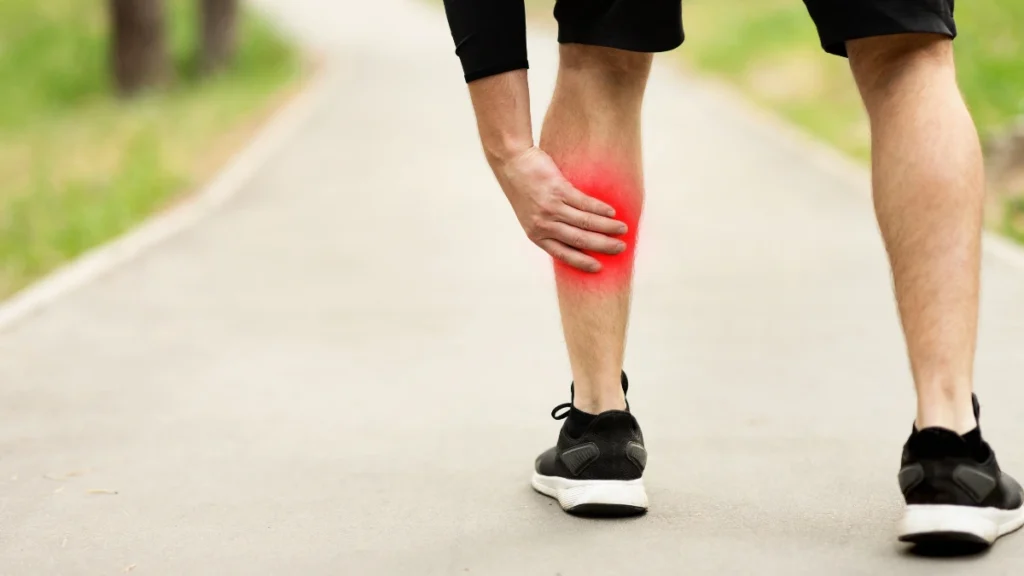
- The large majority of calf pain is not related to the arteries at all. Everyday causes such as muscle cramps, ordinary soreness after activity, and minor strains are far more common, and most of the time the explanation is simple and harmless.
- Night cramps and post-exercise aches are some of the most common reasons people feel calf pain, and they usually settle on their own without any cause for concern.
- There is one specific pattern worth knowing about: a cramp that comes on at a predictable walking distance and eases within a few minutes of rest. This pattern, called claudication, is the one that can point to the arteries.
- Claudication is the main symptom of peripheral arterial disease (PAD). It is far less common than ordinary muscle pain, but it is worth recognising because it responds very well to straightforward treatment.
- If your calf pain follows that predictable walking-and-resting pattern, it is worth a calm conversation with your GP. For most other calf pain, reassurance and simple measures are usually all that is needed.
That familiar aching cramp in the calf, the one that arrives after a long day on your feet or wakes you in the night, is something almost everyone experiences at some point. It is easy to start worrying about what it might mean. In the great majority of cases, though, the explanation is reassuringly ordinary: a muscle cramp, a little soreness, or a minor strain.
Calf pain is rarely a sign of anything to do with your arteries or your heart. The everyday causes are far more common, and most of them settle on their own. This article walks through those common explanations first, because they account for most calf pain, and then explains the one specific pattern that is worth knowing about, so you can tell the difference with confidence.
Most Calf Pain Has a Simple Explanation
It is worth saying clearly at the outset: calf pain has many possible causes, and the common ones are harmless. For most people, the discomfort comes down to the muscle itself rather than anything in the blood vessels.
Muscle cramps are extremely common. They often strike at night or after a long period of sitting, and they are frequently linked to nothing more than dehydration or a temporary imbalance in the body’s salts. A good stretch, some gentle movement, and staying well hydrated are usually enough. These cramps can be sharp and uncomfortable, but they are not a sign of anything wrong with the circulation.
Ordinary muscle soreness is another very common cause. A new exercise routine, a longer walk than usual, a session at the gym, or returning to sport after a break can all leave the calves aching for a day or two. Calf strains and minor soft tissue injuries cause a more localised pain that is tender to touch and tends to ease with rest and time. None of these has anything to do with the arteries.
So if your calf pain is occasional, linked to activity or a poor night’s sleep, or simply comes and goes without a clear pattern, the odds are strongly in your favour that it is one of these everyday causes.
One other cause is worth a brief mention for completeness: deep vein thrombosis, a clot in the deep veins of the leg. This is different from the muscle causes above and from the arterial pattern described below. It tends to cause a constant ache or tightness with swelling, warmth, or redness, and it is not brought on by walking. It is uncommon, but if your calf becomes swollen and tender, particularly after a long flight, surgery, or a spell of being less mobile, it is sensible to have it checked promptly.
With the common causes covered, there is just one specific pattern that points away from the muscle and towards the arteries. It is much less common, but it is the one situation where calf pain is worth a closer look. The cards below show how the everyday causes compare with that pattern.
Most common
Cramp or strain (muscle)
Often arrives at night or after a new activity, can be tender to touch, and does not follow a set walking distance. Usually harmless and settles on its own.
Uncommon
A clot (vein)
A constant ache with swelling, warmth, or redness, not linked to walking. Worth a prompt check, especially after travel or surgery.
Less common
Claudication (arterial)
Comes on at a predictable walking distance, eases within minutes of stopping, and tends to repeat the same way each day. The one pattern worth checking.
The One Pattern Worth Knowing: Claudication
Claudication is the medical term for leg pain, most often in the calf, but sometimes the thigh or buttock, that comes on during walking and reliably eases within a few minutes of rest. The pattern is highly predictable. You walk a certain distance, the calf begins to cramp and ache, you stop, it settles, and you can walk again. The distance you can manage before the discomfort sets in is often fairly consistent from day to day. It is this consistency, rather than the cramp itself, that sets it apart from ordinary muscle pain.
This happens because the arteries supplying blood to the leg muscles have become narrowed by a gradual build-up of fatty plaque. It is the same process, called atherosclerosis, that affects the heart arteries. During exercise, the leg muscles ask for more oxygen-rich blood. If the arteries are narrowed, supply cannot quite match demand, and the muscle responds with that characteristic ache. At rest the demand falls, blood flow catches up, and the discomfort clears.
The key feature of claudication is its predictability. It comes on with a consistent amount of walking and clears reliably with rest. Once that pattern is recognised, it is well worth a calm conversation with your doctor.
The Underlying Condition: Peripheral Arterial Disease
Claudication is the hallmark symptom of peripheral arterial disease (PAD), sometimes also called peripheral vascular disease, which refers to narrowing of the arteries that supply the legs. The risk factors are almost identical to those for heart disease, so if you have been told you carry an increased cardiovascular risk, your chance of PAD is raised too.
The main risk factors include:
- Smoking, by far the strongest risk factor for PAD. Even a past smoking history meaningfully increases risk.
- Diabetes, which accelerates arterial narrowing and can also affect the nerves in a way that masks symptoms.
- High blood pressure.
- High cholesterol.
- Increasing age, with PAD becoming more common from around the age of 50.
- A family history of cardiovascular disease.
You can review the full picture in our guide to understanding your cardiovascular risk factors, which is a useful starting point for getting a sense of your own profile.
Why PAD Is More Than Just a Leg Problem
This is the point that many people, and sometimes their clinicians, underappreciate. PAD is not only a condition of the legs. It can be a marker of atherosclerosis elsewhere, a signal that the same gradual process may be present in arteries throughout the body, including those supplying the heart and brain.
For that reason, finding PAD is genuinely useful. It is a prompt for a broader cardiovascular review rather than attention to the legs in isolation. Rather than being a cause for alarm, it is an opportunity to look at the whole picture and to act on the risk factors that matter most.
What the Doctor Will Look For
The assessment for suspected PAD is thorough and extends well beyond the legs. Your doctor will take a detailed history of your symptoms, the distance you can walk, how long recovery takes, and whether any discomfort occurs at rest, and will then examine you carefully.
On examination, the findings they look for may include:
- Reduced or harder-to-feel pulses at the foot, ankle, behind the knee, and at the groin.
- Skin changes, such as pale, shiny, or mottled skin over the lower legs and feet.
- Hair loss on the lower legs, a subtle but classic sign of reduced blood flow over time.
- Nail changes, with thickened, slow-growing nails.
- Coolness of the foot or lower leg compared with the other side.
- Any wound on the foot or lower leg that is slow to heal, which is always worth showing your doctor.
Because PAD shares its risk factors with heart disease, your doctor will usually look beyond the legs as well. An ECG may be performed to check the heart’s rhythm and electrical pattern. An echocardiogram, an ultrasound of the heart, may follow to assess how the heart is functioning. In some people a stress test is also worthwhile, to check for any coronary artery disease that is not yet causing symptoms.
Investigations: From Bedside to Detailed Imaging
The first-line investigation is simple, comfortable, and can be done in the clinic. The ankle-brachial index compares the blood pressure measured at the ankle with that at the arm, using a blood pressure cuff and a small handheld ultrasound probe. In a healthy circulation, the ankle pressure should be about the same as, or slightly higher than, the arm pressure. A lower ankle reading suggests narrowing in the leg arteries.
If that result is abnormal, further imaging helps to map the picture more precisely:
- Duplex ultrasound, which uses sound waves to show blood flow through the arteries and pinpoint any narrowings, without radiation or dye.
- CT angiography, a cross-sectional scan using a contrast dye that produces detailed images of the arteries from the abdomen down to the foot, which is excellent for planning treatment.
- Conventional angiography, a catheter-based procedure where dye is injected directly into the arteries under X-ray guidance, usually reserved for when treatment is being carried out at the same time.
The ankle-brachial index is one of the most useful and underused tests in general practice. It is quick, comfortable, and inexpensive, and in the right person it can be genuinely informative.
Treatment: Starting With the Fundamentals
The foundation of treatment for PAD is managing cardiovascular risk factors, and this overlaps almost entirely with the management of heart disease. The aims are to slow the progression of atherosclerosis and to look after the heart and brain, as much as to improve the leg symptoms themselves.
Stopping smoking is the single most valuable change anyone with PAD can make, and its effect on the course of the disease is substantial and well documented. Cholesterol-lowering treatment with a statin, blood pressure control, and antiplatelet treatment (commonly low-dose aspirin or clopidogrel) are all standard parts of care. In people with diabetes, steady glucose control matters too. These decisions are individual, and your cardiologist or GP is best placed to advise on what is right for you.
Supervised exercise rehabilitation, particularly structured walking programmes, has strong evidence behind it and is often underestimated. Walking regularly to the point of mild discomfort, and then a little further, encourages the body to develop small collateral vessels that help route blood around the narrowed segments. It can feel counterintuitive, but it works, and for milder disease the benefit is comparable to some procedures.
Procedures and Surgery, When They Are Needed
When symptoms are significantly limiting day-to-day life, or when blood flow is more seriously reduced, more involved options come into consideration. At that stage, referral to a vascular surgeon or a specialist centre is appropriate.
Endovascular treatment involves passing a fine catheter through the artery, usually from the groin, to the narrowed segment. Options include balloon angioplasty, which gently opens the narrowed segment; stenting, where a small scaffold holds the artery open; and atherectomy, where specialised devices remove hardened plaque. Surgical bypass uses a vein or synthetic graft to reroute blood around a blocked segment, and is generally reserved for more complex situations or where other approaches are not suitable.
The choice between these depends on where the narrowing is, how extensive it is, your overall fitness, and the expertise available. These decisions are usually made together in a specialist team discussion, with you involved throughout.
When to Seek Help Sooner
Most people with claudication have plenty of time to be assessed in an unhurried, outpatient setting. A small number of symptoms, though, are worth acting on the same day. Pain in the foot or lower leg that is present at rest, a foot that becomes cold, pale, or mottled, a sudden and marked drop in how far you can walk, or a wound on the foot that is not healing all deserve prompt review. If you notice any of these, contact your doctor the same day or attend an emergency department, as they can indicate a more serious reduction in blood flow that is best treated quickly.
Conclusion
The most important message is the most reassuring one: the large majority of calf pain is harmless. Muscle cramps, ordinary soreness, and minor strains account for most of it, and they usually settle with rest, gentle movement, and time. If your calf pain comes and goes without a clear pattern, it is very unlikely to have anything to do with your arteries.
There is just one pattern worth keeping in mind: a cramp that arrives at a predictable walking distance and eases within a few minutes of stopping. If that sounds like your experience, it is worth a calm, unhurried conversation with your GP, because it responds very well to straightforward treatment. For everything else, a little reassurance is usually all that is needed.
Related Reading
- What Is Atherosclerosis?
- Understanding Your Cardiovascular Risk Factors
- Smoking and Your Heart: Understanding the Risks
- Walking and Your Heart: Why the Simplest Exercise Is Often the Best
- Blood Clots: Understanding DVT, Pulmonary Embolism and How They Are Treated
- What Is Clopidogrel Used For?
- Aspirin and Heart Health: What the Latest Evidence Shows