- POTS, Postural Orthostatic Tachycardia Syndrome, is a condition of the autonomic nervous system in which heart rate rises excessively on standing, producing symptoms that can be profoundly disabling.
- The hallmark is a heart rate increase of 30 beats per minute or more within 10 minutes of standing, without a significant fall in blood pressure, accompanied by a characteristic symptom pattern.
- Symptoms include dizziness, lightheadedness, palpitations, fatigue, brain fog, and near-fainting on standing, often dramatically improved by lying down, which is one of the most diagnostically telling features.
- POTS is not rare, it predominantly affects women between the ages of 15 and 50, and is significantly under-diagnosed. Many patients spend years being told their symptoms are anxiety or deconditioning before receiving a correct diagnosis.
- While POTS can be debilitating, a structured management approach, combining lifestyle strategies, physical reconditioning, and where needed medications, produces meaningful improvement in the majority of patients. Specialist clinic input is an important part of optimal care.
POTS is one of those conditions where the journey to diagnosis is often as difficult as the condition itself. Patients, most of them young, arrive in my clinic having seen multiple doctors, having been told their palpitations are anxiety, their fatigue is depression, their dizziness is nothing to worry about. Some have been told there is nothing wrong. Others have been given a diagnosis of chronic fatigue, fibromyalgia, or panic disorder, and while these may coexist, they are not POTS, and treating them alone leaves the underlying autonomic dysfunction unaddressed.
The relief that comes when POTS is finally named and explained, when a patient understands that their symptoms have a physiological basis that is measurable and treatable, is one of the more meaningful moments in a consultation. It does not make the condition less challenging. But it makes it navigable.
This article is for patients who suspect they may have POTS, who have recently been diagnosed, or who are trying to understand a condition that is often poorly explained. The message I want to convey from the outset is this: POTS is real, it is complex, it is frequently underestimated, and with the right approach, most people do meaningfully better.
What Is POTS?
The autonomic nervous system
The autonomic nervous system regulates the body’s automatic functions, heart rate, blood pressure, breathing, digestion, without conscious effort. When you stand up, it orchestrates an immediate response: blood vessels in the legs constrict to prevent blood pooling downward, and the heart rate adjusts to maintain adequate blood flow to the brain. In most people this happens seamlessly and invisibly.
In POTS, this orchestration is dysregulated. When standing, blood pools excessively in the lower body. The autonomic nervous system compensates with a disproportionate surge in heart rate, but this response is not fully effective, and the brain and upper body receive inadequate perfusion. The result is the characteristic symptom cluster of POTS: dizziness, palpitations, fatigue, and cognitive fog that appear on standing and improve dramatically on lying down.
The diagnostic criteria
The formal diagnostic criterion for POTS is a sustained heart rate increase of 30 beats per minute or more within 10 minutes of standing, or a heart rate exceeding 120 beats per minute on standing, in the absence of orthostatic hypotension (a significant fall in blood pressure on standing). In adolescents, the threshold is a rise of 40 beats per minute.
The key distinction from a simple faint or vasovagal episode is that in POTS, the blood pressure does not fall significantly, it is the heart rate that is the primary abnormality, compensating for inadequate venous return with a dramatic and sustained tachycardia.
What Does POTS Feel Like?
The upright-to-horizontal contrast
One of the most revealing features of POTS, both for diagnosis and for the patient’s own understanding, is how dramatically symptoms vary with position. Standing or sitting upright produces symptoms. Lying down relieves them, often within minutes. This positional dependence is so characteristic that many patients learn to structure their lives around it before they have any diagnosis, lying down after meals, avoiding prolonged standing, sitting rather than standing whenever possible.
When patients describe having to lie on the supermarket floor, or being unable to stand in the shower, or feeling well in bed but incapacitated within minutes of getting up, that history is POTS until proven otherwise.
The symptom cluster
Palpitations
Racing heart on standing, often the most alarming feature. The heart rate surge is real and measurable, not imagined.
Dizziness and lightheadedness
On standing, prolonged standing, or after meals. Reflects inadequate cerebral perfusion despite the compensatory tachycardia.
Profound fatigue
Not ordinary tiredness, a heavy, persistent exhaustion that does not resolve with rest and is worsened by upright activity.
Brain fog
Difficulty concentrating, slowed thinking, memory problems. Reflects reduced cerebral blood flow rather than a primary neurological disorder.
Near-fainting (presyncope)
The feeling of being about to faint, often without actually losing consciousness. Many patients faint eventually but presyncope is more common.
Other autonomic features
Nausea, sweating, temperature dysregulation, headache, and sleep disturbance are common, reflecting the broader autonomic nervous system dysfunction.
Who Gets POTS and Why?
Demographics
POTS predominantly affects women, around 80% of cases, typically between the ages of 15 and 50. The onset is often in adolescence or young adulthood. It is estimated to affect between one and three million people in the United States alone, making it considerably more common than many conditions that receive far greater clinical attention.
Triggers and associations
POTS can develop after a viral illness, a pattern that has been particularly well documented following COVID-19, where post-COVID POTS has been identified as one of the more prevalent long COVID manifestations. Other recognised triggers include significant physical deconditioning, pregnancy, surgery, trauma, and puberty. In some patients there is no identifiable trigger, the autonomic dysregulation appears to be constitutional.
Associated conditions include hypermobile Ehlers-Danlos syndrome, a connective tissue disorder characterised by joint hypermobility, which is found in a significant proportion of patients with POTS. Mast cell activation syndrome, autoimmune conditions, and small fibre neuropathy are also more common in the POTS population than in the general population. These associations are clinically important because they influence investigation and management.
Subtypes
POTS is not a single pathophysiological entity, several distinct subtypes have been described, each with different underlying mechanisms. Hypovolaemic POTS involves a reduced circulating blood volume. Neuropathic POTS involves partial autonomic denervation of the lower limb blood vessels. Hyperadrenergic POTS involves excessive sympathetic nervous system activity. Understanding the subtype, where this is possible, helps guide treatment selection. This is one of the reasons specialist clinic input is so valuable.
Diagnosis
The active stand test
The simplest diagnostic assessment is the active stand test, measuring heart rate and blood pressure after lying supine for 10 minutes, then at intervals over 10 minutes of standing. A sustained heart rate rise of 30 beats per minute or more (40 in adolescents), with symptoms, and without significant blood pressure fall, meets the diagnostic criteria.
Tilt table testing
For a more controlled assessment, or when the active stand test is inconclusive, a tilt table test is performed. The patient is strapped to a table that is tilted from horizontal to 70 degrees and held there for up to 45 minutes while heart rate and blood pressure are continuously monitored. This test is the gold standard for diagnosing POTS and other forms of orthostatic intolerance.
Further investigation
Blood tests assess for common associated conditions, thyroid function, anaemia, autoimmune markers, and plasma volume studies where available. A 24-hour Holter monitor documents the heart rate patterns throughout a normal day. Echocardiography confirms normal cardiac structure and function. Skin biopsy for small fibre neuropathy may be considered in specialist centres.
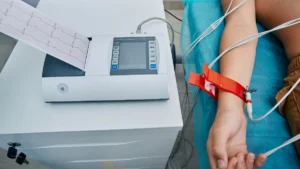
One of the most validating moments for a patient with POTS is seeing their own heart rate trace on a monitor, watching it jump from 70 to 130 beats per minute simply on standing. For someone who has been told for years that their symptoms are anxiety or deconditioning, seeing the objective evidence of what their body is doing is genuinely transformative. It changes the conversation from “is this real?” to “what are we going to do about it?”, and that is a much better conversation to be having.
— Prof. Peter Barlis, Interventional Cardiologist
Management
Why a specialist clinic matters
POTS is best managed by a multidisciplinary team with experience in autonomic disorders. In Australia, POTS clinics, typically combining cardiology, neurology, and physiotherapy, offer the comprehensive, coordinated approach that this condition requires. A cardiologist managing a patient with POTS in isolation can help, but the physiotherapy reconditioning programme, the dietary advice, the psychological support for coping with a chronic and often poorly understood condition, these are best provided by a team that has developed expertise in this specific patient group.
If you have been diagnosed with POTS and are not yet under the care of a specialist clinic, asking for a referral is a worthwhile conversation to have.
Non-pharmacological strategies, the foundation
The core of POTS management is non-pharmacological, and for many patients, these measures alone produce significant improvement.
Fluid and salt loading is fundamental. Increasing fluid intake to two to three litres of water per day and increasing dietary salt, in the absence of hypertension, expands circulating blood volume and reduces the degree of orthostatic pooling. Many patients notice improvement within days of implementing this consistently.
Compression garments, waist-high graduated compression stockings or abdominal binders, physically counteract blood pooling in the lower body on standing. They are unglamorous but effective, and most patients who use them consistently find them meaningful.
Physical reconditioning is one of the most impactful and most challenging elements of management. Deconditioning worsens POTS significantly, yet upright exercise is poorly tolerated in active POTS. The key is starting with recumbent exercise, rowing machines, recumbent cycling, swimming, that achieves cardiovascular conditioning without the orthostatic stress of being upright. Gradually, as tolerance improves, more upright exercise can be introduced. This process takes months and requires patience, but the functional gains are real and durable.
Practical behavioural strategies make a significant difference to daily functioning, elevating the head of the bed by 10 to 20 degrees, rising from lying slowly, avoiding prolonged standing, eating smaller and more frequent meals (large meals divert blood to the gut), and avoiding heat and dehydration.
Medications
When non-pharmacological measures are insufficient, several medications have evidence supporting their use in POTS. Fludrocortisone increases salt and water retention, expanding blood volume. Midodrine is a vasoconstrictor that increases peripheral vascular resistance and reduces pooling, it is taken in doses timed around upright activity and cannot be taken at night. Beta-blockers, particularly low-dose propranolol, reduce the heart rate surge on standing and can alleviate the palpitation component significantly, though they need to be used carefully as they can worsen fatigue. Ivabradine, a selective heart rate-slowing agent without the side effects of beta-blockers, has shown benefit in POTS and is increasingly used.
The right medication, and the right dose, varies significantly between patients and subtypes. This is another reason why specialist clinic input matters: the trial-and-error process of finding what works for an individual patient is better navigated with experience.
Pacing and long-term outlook
POTS is not a progressive condition in the way that heart failure or coronary artery disease is, it does not inevitably worsen over time. Many patients, particularly those who develop POTS in adolescence, improve significantly as they mature. Those who develop it after a trigger such as a viral illness often improve meaningfully once the underlying trigger resolves and they have completed a structured reconditioning programme.
The trajectory varies enormously between individuals, some recover to full functional capacity, others manage well with ongoing strategies, and some continue to find the condition significantly limiting. Managing expectations honestly while maintaining therapeutic optimism, and adjusting the management approach iteratively as the patient’s condition evolves, is the art of POTS management.
- Has POTS been formally confirmed with an active stand test or tilt table test?
- Is referral to a specialist POTS or autonomic clinic appropriate for my situation?
- Am I implementing the foundational measures, fluid, salt, compression, reconditioning, consistently and correctly?
- Could my POTS be associated with an underlying condition such as hypermobile EDS or an autoimmune process?
- Is my current medication approach optimised, and are there alternatives worth considering?
Heart Matters Resource
When in Doubt, Get Checked Out
If you experience dizziness, palpitations, and profound fatigue on standing that relieves on lying down, and these symptoms have been attributed to anxiety or deconditioning without a formal assessment, asking your doctor about POTS is the right next step.
Conclusion
POTS is a condition that deserves to be taken seriously, by patients, by the clinicians they see, and by the healthcare system that too often dismisses the symptoms before investigating them properly. It is not anxiety. It is not deconditioning, though deconditioning makes it worse. It is an autonomic nervous system disorder with a measurable, objective physiological signature and a range of treatments that meaningfully improve quality of life for most people who receive appropriate care.
The diagnostic journey is often long and frustrating. But a correct diagnosis changes everything, from the framing of the condition, to the management approach, to the patient’s own understanding of why their body responds the way it does.
If you have POTS, or suspect you might: you deserve a proper assessment, a clear explanation, and access to a management approach that goes beyond “drink more water and exercise more.” A specialist POTS clinic is the best environment in which to receive all of that. Ask for a referral if you have not already been offered one.