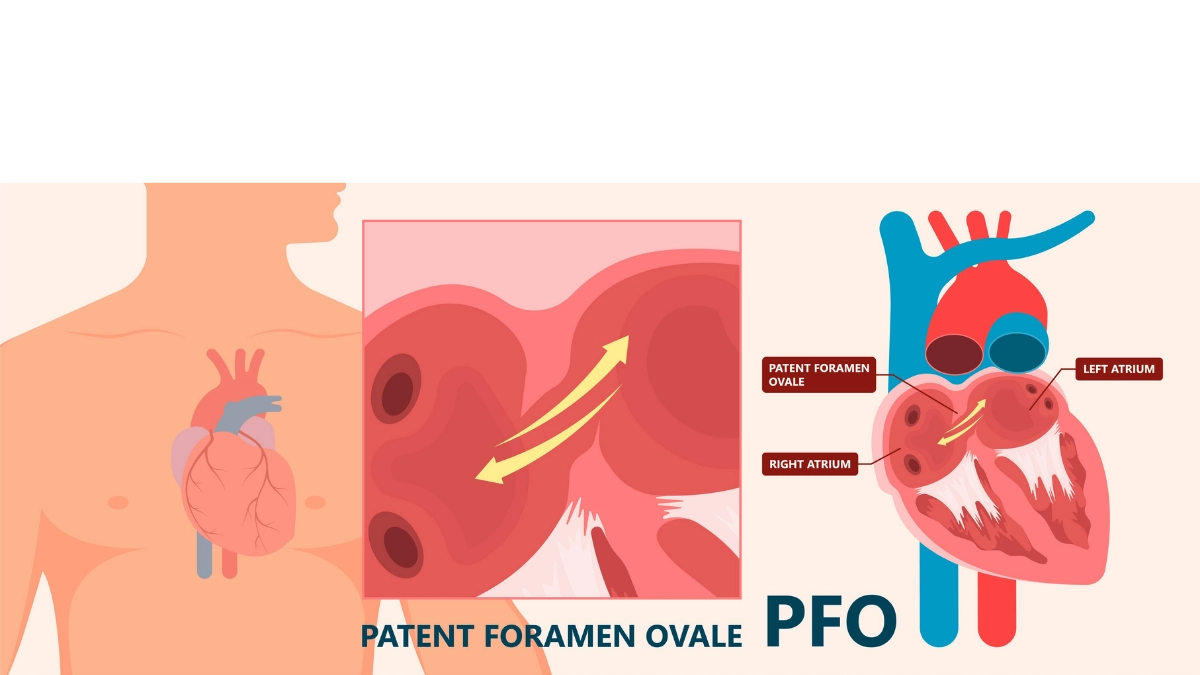
- A patent foramen ovale (PFO) is a small opening between the two upper chambers of the heart, present in roughly one in four adults, that simply did not seal after birth the way it usually does.
- The vast majority of PFOs cause no symptoms and are found by chance. For most people, a PFO needs no treatment at all.
- In a smaller group of patients, particularly those who have had a cryptogenic stroke (a stroke with no identified cause), a PFO may be the route by which a small clot crossed from the right to the left side of the heart and travelled to the brain.
- In selected patients after a cryptogenic stroke, PFO closure (a minimally invasive catheter procedure) lowers the risk of a further stroke and is now supported by strong trial evidence.
- Migraine with aura has a well-recognised association with PFO, though the relationship is complex, and closing a PFO for migraine alone is not currently standard practice.
A patent foramen ovale is one of those findings that can sound alarming when it is first mentioned. A hole in the heart, discovered on an echocardiogram, is not a phrase anyone wants to hear. And yet for most people who have one, it is entirely inconsequential. It requires no treatment, no monitoring, no change to how you live, and nothing you need to act on.
The reassurance I give most patients with a PFO is simple. You have a structural variation that around one in four adults share. In the vast majority of cases it is a finding rather than a diagnosis, something noted and filed, not something that needs managing.
Where it does become clinically relevant, mainly in the setting of an unexplained stroke in a younger person, is a separate and important conversation. But that conversation starts from a very different clinical picture than an incidental echo finding in someone who is otherwise well.
What Is a PFO?
Normal Circulation Before Birth
Before birth, the lungs are not yet doing their job. Rather than breathing, the baby receives oxygen-rich blood from the placenta. To bypass the lungs while they are still at rest, the circulation of every developing baby includes a small opening between the two upper chambers of the heart, called the foramen ovale. Blood passes straight through it from the right side to the left, skipping the lungs entirely.
At birth, the first breath opens the lungs, blood flow through them rises sharply, and the pressure in the left upper chamber climbs above that of the right. This change in pressure presses a small flap of tissue against the opening and seals it. In most people this seal becomes permanent over the first months of life, as the two layers of tissue gradually fuse.
When It Doesn’t Close
In around 25 to 27% of adults, roughly one in four, this fusion does not fully happen. The flap stays unsealed, leaving a potential channel between the two upper chambers that can open at moments of raised pressure on the right side of the heart, such as straining, coughing, or bearing down. This is a patent foramen ovale.
It is not a defect in the usual sense of the word. The heart formed normally, and the closure process simply did not finish. It causes no structural problem, no pressure abnormality, and no effect on how the heart works in the great majority of people who have one.
How Is a PFO Found?
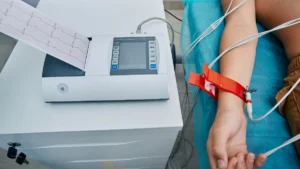
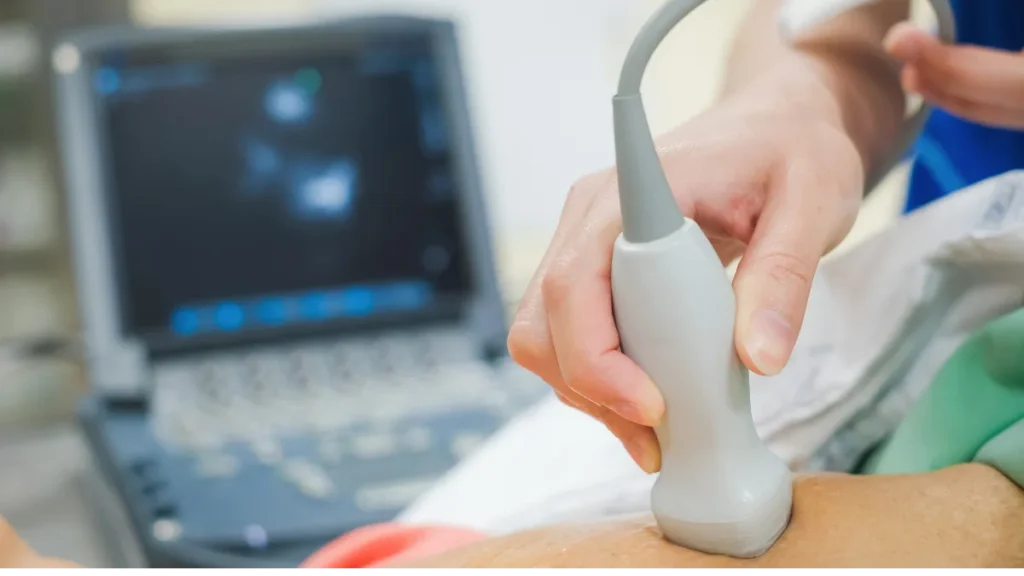
Most PFOs are discovered by chance, on an echocardiogram done for another reason, such as looking into palpitations, a murmur, or as part of a stroke assessment. On a standard echocardiogram a PFO can be hard to see directly. A bubble study, in which a small amount of agitated saline is injected into a vein while you gently bear down, shows the PFO by revealing tiny bubbles crossing from the right chamber to the left. A transoesophageal echocardiogram gives the most detailed picture of a PFO’s size and shape.
Does It Actually Matter? The Context Question
The Incidental PFO, by Far the Most Common Situation
An incidental PFO, found in someone who has not had a stroke, has no neurological symptoms, and is otherwise well, needs no treatment. No blood thinners, no antiplatelet medicine beyond anything already needed for another reason, no closure procedure, and no restriction on activities including diving in most cases (high-altitude diving is a more nuanced discussion worth having with your cardiologist).
The most important thing I tell patients in this situation is that the finding does not change your risk in any way that matters clinically. One in four adults has one, and most go their whole lives without ever knowing.
PFO and Cryptogenic Stroke, the Association That Matters
About 30% of ischaemic strokes have no clear cause even after thorough investigation. These are called cryptogenic strokes. In younger patients who have had a cryptogenic stroke, a PFO is found more often than chance alone would explain, which suggests that in these individuals the PFO may have been the route through which the stroke happened.
The likely mechanism is called paradoxical embolism. A small clot forms in the venous system, often in the leg veins, travels to the right side of the heart, and crosses through the PFO into the left side at a moment of raised pressure, from where it can travel to the brain. This can happen without any obvious sign of a deep vein clot beforehand.
When a brain scan shows several small areas of stroke in different regions, suggesting clots arriving from a single source, a PFO assessment becomes particularly important. This is one reason prolonged heart monitoring for atrial fibrillation often goes hand in hand with a PFO assessment after a cryptogenic stroke. Both conditions can produce a similar pattern of stroke and need to be carefully told apart.
Three landmark randomised trials (RESPECT, CLOSE, and REDUCE) showed that closing a PFO in carefully selected patients after a cryptogenic stroke significantly lowers the risk of another stroke compared with antiplatelet medicine alone. This evidence has made PFO closure a standard recommendation for suitable patients after a cryptogenic stroke, typically those under 60 with a sizeable PFO and no other identified cause for the stroke.
Migraine With Aura
There is a well-documented link between PFO and migraine with aura. A PFO is more common in people who have migraine with aura than in the general population, and some people report fewer migraines after a PFO is closed. However, the trial evidence for closing a PFO specifically to treat migraine is mixed, and closure is not currently recommended for migraine with aura in someone who has not had a stroke. This remains an area of active research, and it is a reasonable thing to ask your cardiologist about if it affects you.
What PFO Closure Involves
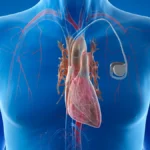
PFO closure is a catheter-based procedure, with no open heart surgery involved. A thin tube is passed through a vein in the groin and guided up into the right upper chamber of the heart. With the help of echocardiography and X-ray guidance, a small device shaped like two discs is positioned across the opening, with one disc resting on each side of the wall. Over the following months, the body’s own tissue grows over the device and seals the opening permanently.
The procedure usually takes 30 to 60 minutes under sedation or light general anaesthesia, and most people go home the next day. Antiplatelet medicine is taken for a period afterwards, typically about six months, while the device becomes covered by the heart’s own lining. The long-term results are excellent, and device-related complications are very uncommon.
adults has a patent foramen ovale, making it one of the most common structural variations of the heart. For the great majority it is entirely harmless and needs no treatment.
American Heart Association
| Clinical Situation | Typical Approach | Why |
|---|---|---|
| Incidental PFO, no stroke, no symptoms | Reassurance, no treatment needed | One in four adults has one; the risks of closing it outweigh any benefit |
| Cryptogenic stroke, under 60, no other cause found | PFO closure, strongly considered | Trial evidence shows a meaningful drop in further strokes |
| Cryptogenic stroke, over 60 | Individualised, blood thinners often preferred | Other possible mechanisms more likely; benefit of closure less clear |
| Migraine with aura, no stroke history | No closure, not standard practice | Evidence not yet sufficient; trials ongoing |
| Decompression illness in divers | Individualised assessment | A careful, case-by-case discussion with a specialist |
The most important conversation I have with patients who have a PFO is about context. The finding can be the same in two people. The significance can be entirely different. Context is everything.
Prof. Peter Barlis, Interventional Cardiologist
- My PFO was found by chance. Do I need any treatment, monitoring, or change to how I live?
- I have had a stroke with no identified cause. Is my PFO likely to have been involved, and could I be a candidate for closure?
- What do the size and shape of my PFO mean for my risk? Are all PFOs the same?
- I dive recreationally. Does having a PFO change my risk, and should I adjust how I dive?
- I have migraine with aura. Is there a link with my PFO, and is closure something I should consider?
Heart Matters Resource
When in Doubt, Get Checked Out
If you have been told you have a PFO and are unsure what it means for you, particularly if you have had a neurological event, a cardiology review to put the finding in context is the right next step.
Conclusion
A patent foramen ovale is perhaps the cardiac finding that most needs to be put in context. In the great majority of people who have one, and a quarter of all adults do, it is entirely harmless, needs no intervention, and is nothing you need to act on.
In a carefully defined group of patients, those who have had a cryptogenic stroke at a younger age with no other identifiable cause, closing a PFO is a worthwhile step with strong evidence behind it. The procedure is safe, effective, and minimally invasive.
The key, in the end, is context. The very same finding can mean completely different things depending on the clinical picture in which it is discovered. Your cardiologist’s role is to place that finding in its proper frame, and where that frame is reassurance, the reassurance should be complete and confident.
Related Reading
- What Is Atrial Fibrillation and How Does It Increase Stroke Risk?
- The Echocardiogram: What It Shows and Why It Matters
- Transoesophageal Echocardiogram (TOE/TEE): What It Is and What to Expect
- Stroke and TIA: Understanding What Happened
- Understanding Blood Clots
- Cardiac Monitoring Devices: From Holter to Loop Recorder