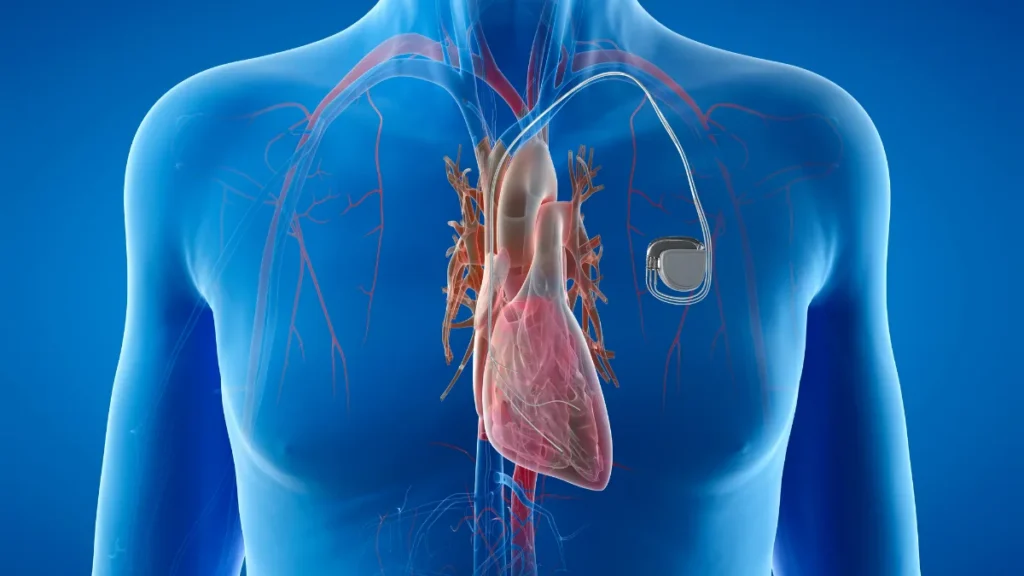
- In complete heart block, also called third-degree AV block, the electrical signals from the top of the heart stop reaching the bottom. The lower chambers fall back on their own slower backup rhythm to keep going.
- Unlike the milder degrees of block, this one usually causes symptoms and usually needs treating. Fainting, near-fainting, marked breathlessness, and profound tiredness are the common ones.
- The most frequent cause is gradual age-related wear in the heart’s wiring. Medications, a recent heart attack, and heart surgery are the other common explanations.
- A pacemaker is the usual treatment, and it is genuinely effective. This is one of the few serious cardiac diagnoses where a single procedure restores normal life almost completely.
- Fainting without warning, particularly in an older person, warrants urgent assessment rather than a wait-and-see approach, because it can be the first sign.
Of all the findings that appear on an ECG report, complete heart block is the one where the alarming name is closest to the truth. Where a first-degree block is really just a delay, and a second-degree block means the occasional missed beat, complete heart block means what it says. The signal is not getting through at all.
That sounds frightening, and it is a serious diagnosis. But it also happens to be one of the most fixable problems in cardiology. The heart has a built-in fallback that keeps things going, and modern treatment addresses the underlying fault directly rather than merely managing it.
What Is Actually Happening
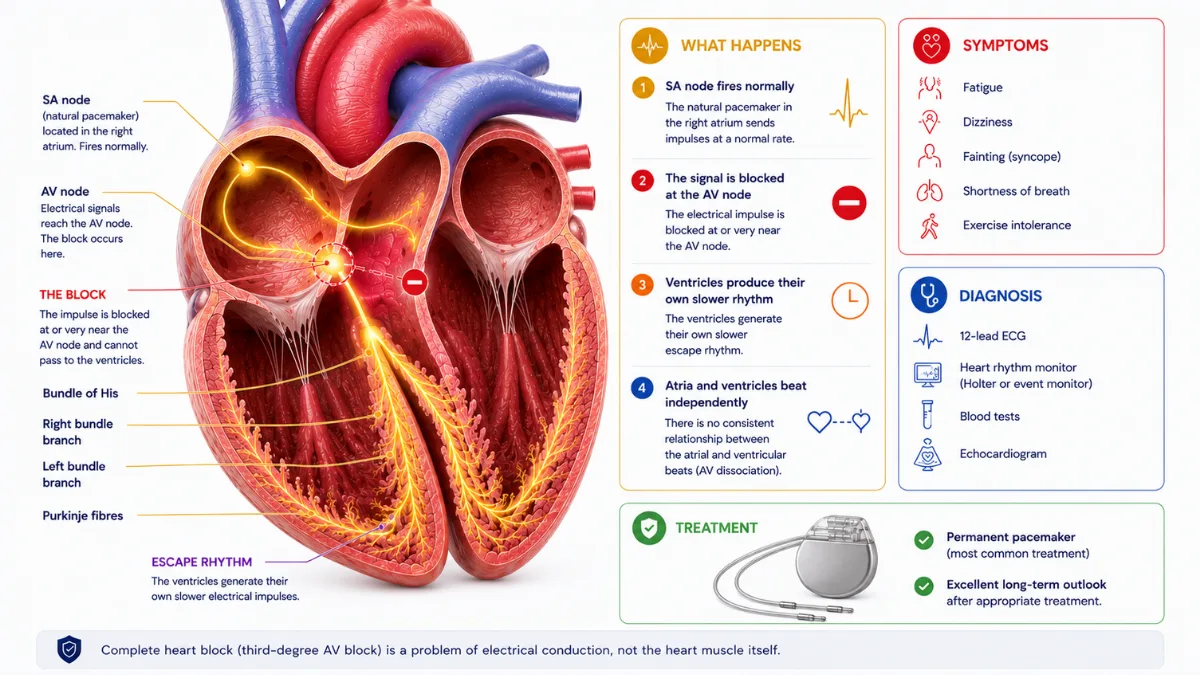
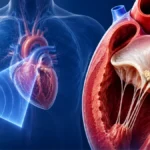
Every heartbeat starts in the upper chambers of the heart, the atria. The signal travels down to a junction called the atrioventricular node, then on to the lower chambers, the ventricles, which do the pumping.
In complete heart block, that connection has failed. The upper chambers carry on firing at their normal rate, entirely unaware that nothing is getting through. The lower chambers, receiving no instruction, fall back on their own built-in backup pacemaker.
This backup exists precisely for this situation, and it is why complete heart block is not immediately fatal. But it is a poor substitute. It fires slowly, often somewhere between 20 and 40 beats per minute against a normal 60 to 100, and unlike the normal rhythm it does not speed up when you climb stairs or hurry for a bus.
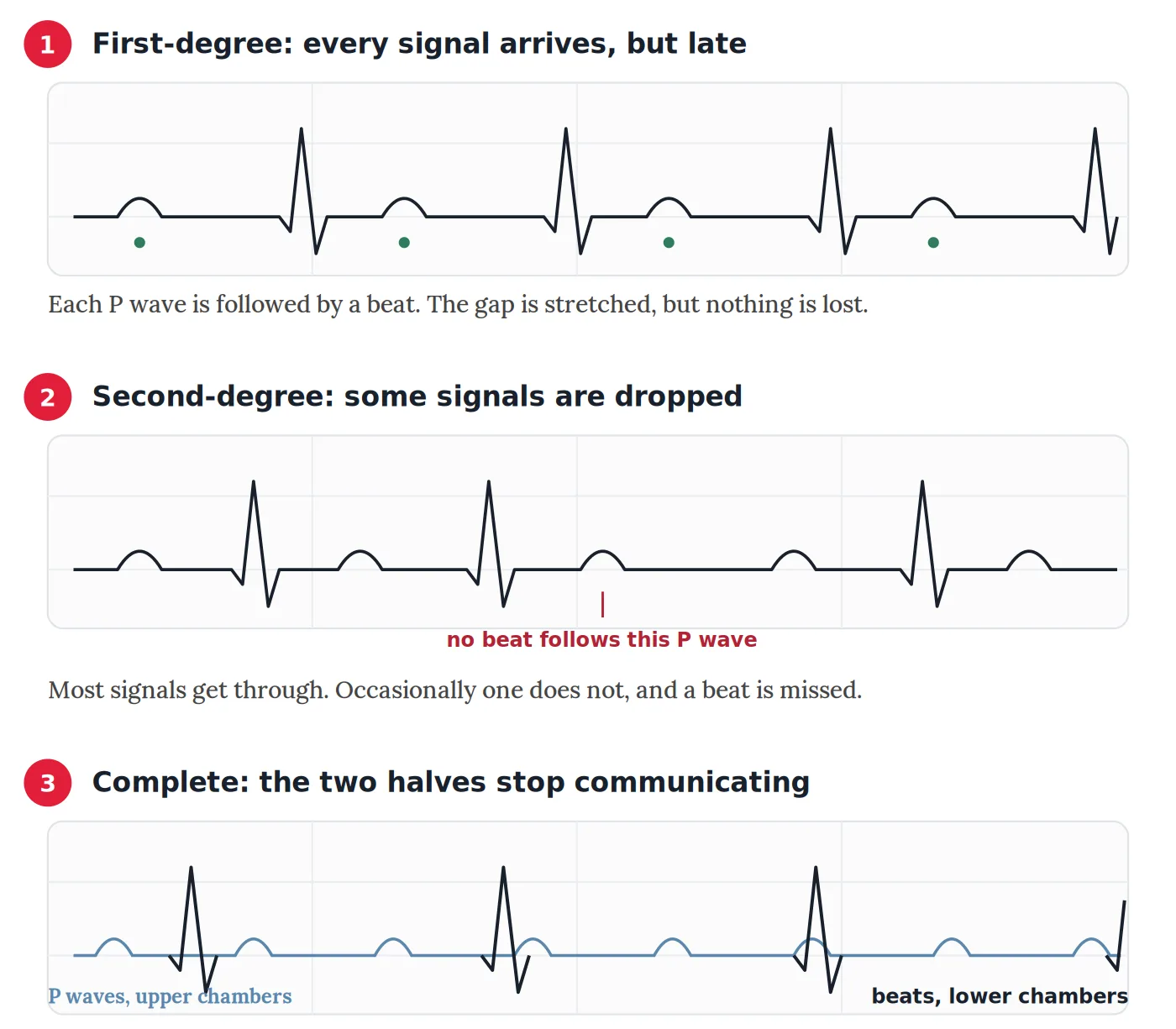
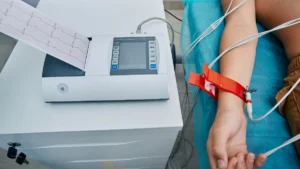
On the ECG this produces a distinctive pattern that a cardiologist can recognise instantly. The P waves are regular. The beats are regular. But they bear no relationship to one another, each marching to its own timing. Doctors call this atrioventricular dissociation, and it is the signature of the diagnosis.
What It Feels Like
Most people with complete heart block feel something is wrong, though what they feel varies a great deal and is often mistaken for something else.
Fainting or near-fainting is the classic presentation, and it has a particular character. There is often no warning, no dizziness building beforehand, no sense of the world closing in. The person is simply on the floor, and then, usually within a minute, entirely alert again. That pattern of sudden collapse with rapid full recovery is quite specific, and it is worth describing precisely to a doctor, because it points towards a rhythm cause rather than the many other reasons for fainting.
Breathlessness and exhaustion are common and often the earlier signs. With a heart rate stuck at 35 and unable to rise, ordinary exertion becomes hard work. People frequently put this down to age or being out of condition, sometimes for months.
Chest discomfort, confusion, or a general sense of being unwell can appear too, particularly in older people, where the presentation can be vague enough that the heart is not the first suspicion.
A pulse that is persistently very slow is the physical sign, and it is often what prompts the ECG in the first place. Some people, though, feel surprisingly little, particularly if the block came on gradually and the backup rhythm is at the faster end of its range.
Fainting with no warning and full recovery within a minute is one of the more specific stories in cardiology. It is worth describing exactly as it happened.
What Causes It
Age-related wear is the most common cause by some margin. The heart’s conduction tissue develops fibrous change over decades, much as other tissues do, and eventually the connection fails. This is why complete heart block is predominantly a condition of later life and often arrives without any other heart disease at all.
Medications can cause it or contribute to it. Beta-blockers, certain calcium channel blockers, digoxin, and antiarrhythmic drugs all slow conduction deliberately. In a conduction system already worn, that can be enough to tip it over. This possibility is always considered, because a block caused by medication may resolve when the medication is adjusted.
A recent heart attack can interrupt the blood supply to the conduction tissue. Block occurring in this setting sometimes recovers over days as the surrounding muscle settles, which is why temporary pacing is often used first rather than going straight to a permanent device.
Heart surgery or valve procedures carry a recognised risk, because the conduction tissue runs close to the aortic valve. Some blocks after these procedures recover and some do not.
Less common causes include infiltrative conditions such as cardiac amyloidosis and sarcoidosis, certain infections, and inflammatory conditions. These are considered particularly when the person is younger than the usual pattern would suggest.
Congenital complete heart block is a separate entity present from birth. The backup rhythm in these cases often sits higher in the conduction system, runs faster, and is better tolerated, so some people live with it for years before it is picked up.
Why This One Is Different
It is worth being clear about why complete heart block is treated more seriously than the milder degrees, because the difference is real rather than a matter of degree.
A backup rhythm is not a reliable rhythm. It can slow further, and it can pause. A pause of a few seconds causes a faint. A longer pause is dangerous. The risk is not that the heart is beating slowly today, but that the arrangement keeping it beating at all is not a dependable one.
There is also no medication that fixes it. Slow heart rhythms in general have very few drug options, and none that restore conduction through a failed connection. That is the reason a device is the answer rather than a tablet.
What Happens Next
Confirmed complete heart block usually means admission to hospital rather than management as an outpatient, and things tend to move relatively quickly.
The first step is to look for a reversible cause. Medications that could be responsible are stopped or held. Blood tests check for electrolyte problems and thyroid function. If a recent heart attack is the cause, the situation is watched, because recovery is possible.
Where the heart rate is dangerously slow in the meantime, a temporary pacing wire can be placed to hold things steady while the picture becomes clear.
If the block is not reversible, and in most cases it is not, a permanent pacemaker is the treatment. The procedure is usually done under local anaesthetic with sedation, takes an hour or two, and most people go home the following day.
The Genuinely Reassuring Part
Complete heart block is a serious diagnosis with an unusually good ending. A pacemaker does not manage the problem or slow its progression. It replaces the failed connection and restores a normal heart rate, including the ability to speed up on exertion, which modern devices handle automatically.
People who were fainting stop fainting. People who had become breathless walking to the shops generally find that resolves. Life expectancy for someone with a pacemaker for heart block is close to that of anyone else their age.
The trade-offs are real but modest: a small scar below the collarbone, periodic device checks, a battery change every several years, and a few practical considerations around strong magnetic fields. Set against a heart that was stopping intermittently, most people regard that as a fair exchange.
When to Seek Urgent Help
Call your local emergency number if any of the following occur:
- Fainting or collapse without warning, particularly if it has happened more than once.
- A pulse that is persistently very slow alongside breathlessness, confusion, or chest discomfort.
- Near-fainting on standing or on exertion that is new or worsening.
Fainting has many causes and most are not dangerous. What makes it worth treating urgently is the combination of no warning, rapid full recovery, and older age, because that pattern can be the first presentation of a conduction problem. An ECG at the time settles it quickly.
Conclusion
Complete heart block is the one degree of AV block where the alarming name matches the situation. The connection between the top and bottom of the heart has failed, and what is keeping things going is a backup that was never meant to run the show.
It is also, once identified, among the most solvable problems in cardiology. A single procedure restores what was lost, and people generally return to the life they had before the symptoms started. The part that matters is getting to the diagnosis, which is why unexplained fainting in an older person is worth taking seriously rather than putting down to a funny turn. Anyone who has had that experience, or who has been told their pulse is unusually slow, would reasonably want an ECG and a conversation with their doctor about it.
Related Reading
- First-Degree AV Block on Your ECG: What Does It Really Mean?
- When a Slow Heart Rate Is Not Normal: Understanding Bradycardia
- What You Need to Know About Pacemakers
- Leadless Pacemakers: A New Era in Cardiac Pacing
- Fainting Spells: What Syncope Might Be Telling You
- The Electrocardiogram (ECG / EKG)
- When a Standard ECG Isn’t Enough: A Guide to Cardiac Monitoring