- Blood pressure that stays above target despite three or more medications is called resistant hypertension, and it carries a higher risk of stroke, heart attack, and kidney disease than blood pressure that responds to treatment.
- Much of what looks resistant turns out not to be. Missed doses, clinic anxiety, and everyday medicines such as anti-inflammatory painkillers all push readings up, and each is checked before the label is applied.
- A treatable underlying cause is found in a meaningful proportion of cases. Obstructive sleep apnoea, excess aldosterone, and kidney disease are the ones most often missed.
- Adding spironolactone as a fourth medication has the strongest evidence behind it and is what most guidelines recommend when a standard three-drug combination is not enough.
- Renal denervation is a catheter procedure now approved in several countries, but the benefit is modest and it is reserved for a small group of patients who have already exhausted medication options in a specialist clinic.
Blood pressure that will not come down is one of the more disheartening situations in medicine. The tablets are being taken. The salt has come out of the cooking. The walking has started. The numbers have barely moved.
This has a name. Resistant hypertension describes blood pressure that stays above target despite treatment with three or more medications, and it is far more common than most people realise.
It is also, in a large proportion of cases, explainable. The work of sorting it out is methodical rather than dramatic, and understanding the sequence makes it much easier to follow what a cardiologist is doing and why.
What Resistant Hypertension Actually Means
The formal definition is blood pressure that remains above target despite three or more blood pressure medications at appropriate doses, ideally including a diuretic, which is the water tablet in most regimens. Someone whose blood pressure is only controlled because they are taking four or more medications also falls under the same heading.
The label matters because it changes what happens next. It signals that the standard approach has run out, and that a systematic search is warranted rather than another dose increase.
people treated for high blood pressure have readings that stay above target, making this one of the largest unsolved problems in cardiovascular medicine.
American Heart Association
The Checks That Come First
Before the label is accepted, three things get ruled out. This is not a formality. A large share of apparently resistant blood pressure turns out to have an ordinary explanation.
Whether the treatment is being taken as prescribed
This is the single most common reason blood pressure looks resistant when it is not. Taking four or five tablets a day for decades is genuinely difficult, and studies measuring drug levels in blood or urine consistently find that a substantial minority of people with apparently resistant hypertension are not taking everything prescribed.
Clinicians raise it because it changes the diagnosis, not to apportion blame. An honest conversation here often saves a patient from a round of unnecessary investigations.
Whether the readings are accurate
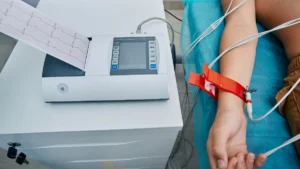
Blood pressure measured in a clinic can run considerably higher than the same person’s readings at home, a pattern often called white coat hypertension. Cuff size, arm position, and a rushed measurement after climbing stairs shift the number too.
This is why a diagnosis of resistant hypertension usually rests on home blood pressure readings or 24-hour ambulatory monitoring rather than clinic readings alone. A fuller explanation of what the numbers mean is available separately.
Whether something else is raising the pressure
Several common medicines raise blood pressure in their own right. Anti-inflammatory painkillers such as ibuprofen are the most frequent culprit, along with some nasal decongestants, certain oral contraceptives, corticosteroids, and some herbal preparations. Liquorice, taken regularly and in quantity, does it too.
A full medication review, including anything bought over the counter, is a standard part of the assessment.
Secondary Causes Worth Excluding
A smaller but important group of patients have an identifiable condition driving their blood pressure. Finding one can transform control without adding another tablet.
- Obstructive sleep apnoea. Repeated interruptions to breathing overnight trigger the body’s stress response hundreds of times before morning. It is strongly associated with resistant hypertension and remains substantially underdiagnosed.
- Primary aldosteronism. Excess production of the hormone aldosterone by the adrenal glands is found far more often in resistant hypertension than was once assumed, and it responds to specific treatment. A simple blood test starts the assessment.
- Chronic kidney disease. The kidneys regulate blood pressure and are also damaged by it, so the relationship runs in both directions.
- Thyroid and other hormonal disorders. An overactive or underactive thyroid, and rarer conditions such as phaeochromocytoma, can all present with difficult blood pressure.
Getting the Medication Combination Right
Where the checks come back clear, attention turns to the combination itself. Guidelines converge on a three-drug foundation: a medication acting on the renin-angiotensin system such as an ACE inhibitor or an angiotensin receptor blocker, a calcium channel blocker, and a thiazide-type diuretic.
The logic is that drugs working through different mechanisms combine better than higher doses of any one of them. Pushing a single agent to its maximum tends to add side effects faster than it adds blood pressure control.
Why spironolactone is usually the fourth
When three medications are not enough, spironolactone is the addition with the best evidence behind it. It blocks the effects of aldosterone, and since excess aldosterone activity drives a substantial share of resistant hypertension, it targets something the standard three-drug combination does not.
The PATHWAY-2 trial compared it directly against the main alternatives in patients whose blood pressure had already failed to respond to three drugs, and spironolactone outperformed them. It is now the preferred fourth agent in major guidelines. It does require monitoring of kidney function and potassium, which the prescribing clinician arranges.
Where it is not tolerated or not suitable, beta-blockers, alpha-blockers, and centrally acting agents all have a place, and nitrate patches, more familiar as an angina treatment, are occasionally used by specialists. Newer agents are in late-stage trials, including a twice-yearly injection.
Where Renal Denervation Fits
Renal denervation comes up in conversations about resistant hypertension more often than its actual role warrants, so it is worth setting out plainly what it is, what the evidence shows, and how narrow the group of suitable patients really is.
What the procedure involves
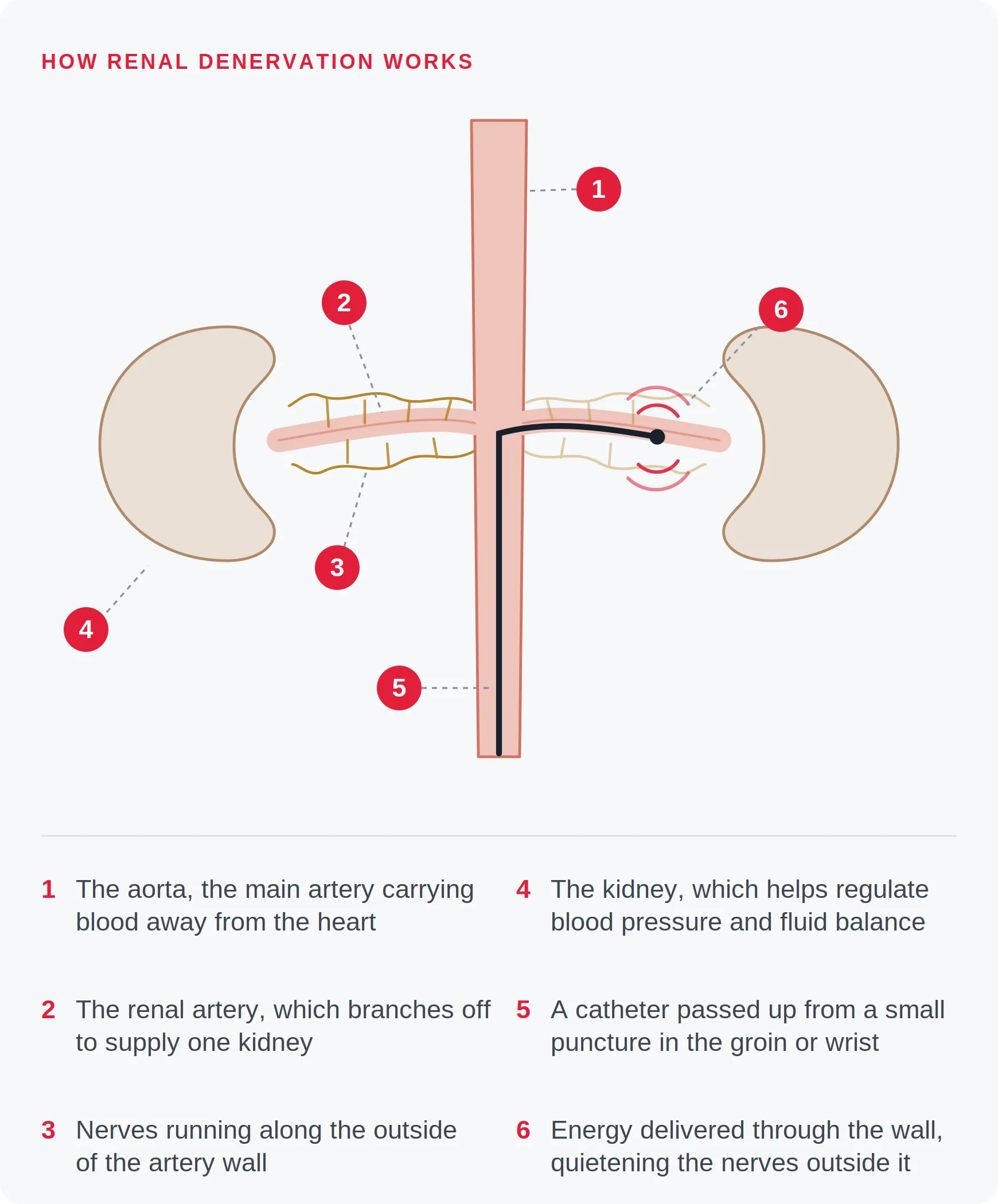
The kidneys are wrapped in a network of nerves that forms part of the body’s stress-response system and helps regulate blood pressure. In some people with resistant hypertension these nerves are persistently overactive. Renal denervation uses a catheter, a thin tube passed through a small puncture in the groin or wrist, to deliver targeted energy to them and reduce their activity. It takes under an hour, and most patients go home the same day.
A history worth knowing
The evidence story is instructive, and it is the reason for the caution that surrounds the procedure today.
Early studies reported blood pressure falls of 25 to 30 points. Thousands of procedures followed, particularly across Europe, before rigorous testing was complete. Then in 2014 the SYMPLICITY HTN-3 trial compared the real procedure against a sham, an identical-looking procedure that did not treat the nerves, with neither patients nor assessors knowing which was which. It found no meaningful difference. The field stopped.
Later analysis identified specific flaws. Medications were changed mid-trial, many operators were performing the procedure for the first time, and the first-generation catheter was less effective than what followed. A second trial, REQUIRE, run across Japan and South Korea during the COVID-19 pandemic, was also neutral, with disrupted follow-up making adherence impossible to verify.
The SPYRAL programme was designed to answer the criticisms, with a better device, tighter monitoring of medications, and experienced operators. At three years of follow-up it showed a sustained difference of roughly 7 mmHg against the sham group. Real-world registry data have been broadly consistent.
average sustained reduction at three years compared with a sham procedure, achieved on top of existing medications rather than instead of them.
SPYRAL HTN-ON MED, three-year follow-up
Renal denervation is not the cure that early enthusiasm suggested. What survived proper testing is a modest, durable benefit for a small and carefully chosen group of patients, which is a more honest place to be.
How narrow the indication is
Regulatory approval followed in the United States in 2024, and both the European Society of Cardiology and the European Society of Hypertension now list it as an option. Two qualifications appear consistently in every guideline that mentions it. It is not a first-line treatment, and it belongs in specialist centres with established experience and a multidisciplinary assessment process.
In practice that means someone who has completed the full workup described above, whose adherence has been verified, whose secondary causes have been excluded, who is on an optimised combination, and whose blood pressure is still well above target. That is a small group. For a patient in it, an extra 7 mmHg sustained over three years is worthwhile, but the procedure adds to medication rather than replacing it. Availability also varies considerably between countries and between centres.
Lifestyle Measures Still Count
None of the above displaces the basics. Lifestyle measures work alongside medication rather than competing with it, and the effect in sodium-sensitive hypertension can be substantial. A fuller guide to lowering blood pressure through daily habits covers this in detail.
Sodium
Most dietary salt comes from processed and packaged food rather than the shaker. Reducing it produces measurable falls in blood pressure, and the effect is largest in people whose hypertension is sodium-sensitive.
Regular activity
Aerobic exercise lowers blood pressure independently of any weight change. Brisk walking on most days is enough to register an effect, and resistance training adds to it.
Alcohol
Alcohol raises blood pressure acutely and over the long term. Cutting back often shows up in home readings within a few weeks. More on alcohol and the heart.
Questions Worth Raising at the Next Appointment
- Has my blood pressure been confirmed as truly resistant, using home or 24-hour readings rather than clinic measurements alone?
- Have secondary causes such as sleep apnoea or primary aldosteronism been investigated?
- Is spironolactone an appropriate addition to my current combination, and what monitoring would it need?
- Are any of my other medicines, including anything I buy over the counter, contributing?
- What is my blood pressure target, and how far above it am I?
- Would a referral to a hypertension specialist be reasonable at this stage?
Heart Matters Resource
When in Doubt, Get Checked Out
Severe headache, chest pain, sudden breathlessness, or visual disturbance in someone with high blood pressure are symptoms that warrant urgent medical assessment rather than waiting for a scheduled appointment.
Conclusion
Resistant hypertension is a description of a situation, not a dead end. Worked through systematically, most cases yield either an explanation for why the readings have stayed high or a combination that finally brings them down, and the single most valuable step is usually the least technical one: confirming what is actually being taken and what the readings truly are away from the clinic.
The options have genuinely widened. Spironolactone as a fourth agent has strong evidence, newer agents are progressing through trials, and for a small, carefully selected group, renal denervation has earned a place after a long and instructive detour. For anyone whose numbers have not shifted, a conversation with their doctor with a fortnight of home readings in hand is where that process usually starts.
Sources and Further Reading
Williams B et al. Spironolactone versus placebo, bisoprolol, and doxazosin to determine the optimal treatment for drug-resistant hypertension (PATHWAY-2). The Lancet, 2015. · Bhatt DL et al. A controlled trial of renal denervation for resistant hypertension (SYMPLICITY HTN-3). New England Journal of Medicine, 2014. · Mahfoud F et al. Long-term efficacy and safety of renal denervation in the presence of antihypertensive drugs (SPYRAL HTN-ON MED). The Lancet, 2022. · Kario K et al. Catheter-based ultrasound renal denervation in resistant hypertension (REQUIRE). Hypertension Research, 2021. · McEvoy JW et al. 2024 ESC Guidelines for the management of elevated blood pressure and hypertension. European Heart Journal, 2024.