- Heart medicines only protect the heart when they are taken, and missing or stopping them is one of the most common reasons treatment works less well than it could.
- People miss or stop medicines for understandable reasons, including feeling well, side effects, a long list of tablets, cost, and confusion after a hospital stay.
- Some heart medicines, such as antiplatelets and beta-blockers, can cause problems if stopped suddenly, which is why changes are usually planned with the prescribing doctor.
- Simple supports such as daily routines, pill organisers, reminders, and an up-to-date medicine list help many people, though what works varies from person to person.
- Pharmacists and doctors can often simplify a routine, change a medicine that is causing side effects, or answer questions about timing and missed doses.
Barely a day goes by in my clinic without a conversation about medicines. Questions about tablets are also one of the most common reasons patients call the office between appointments. I understand why.
Heart medicines can be genuinely confusing. The same medicine can have a generic name, a brand name, and a different-looking packet each time it is dispensed. Some people arrive at an appointment with a shopping bag full of boxes, and for others the morning tablets have become almost a meal in their own right.
Many of these medicines also do not make anyone feel better, at least not straight away. Some can make people feel a little worse at first, perhaps light-headed or tired. They can cause side effects, and the cost adds up. When a medicine brings no obvious benefit day to day, it is entirely reasonable to wonder why it is needed at all.
These are fair questions, and they deserve clear answers. This article explains why taking heart medicines as prescribed matters, why so many people find it hard, and what tends to make it easier.
Why Taking Medicines as Prescribed Matters
Most heart medicines work quietly in the background. Statins lower cholesterol and help stabilise plaque in the arteries. Antiplatelet medicines keep blood from clotting on a stent or a narrowed artery. Blood pressure medicines reduce strain on the heart and blood vessels.
None of these effects can be felt day to day. The benefit shows up as things that do not happen: a second heart attack, a stroke, or a hospital admission. That is exactly why the protection is easy to underestimate, and why it fades when doses are missed regularly.
people with long-term conditions do not take their medicines as prescribed, making this one of the most common challenges in all of medicine.
World Health Organization
Health professionals often use the word “adherence” for this. It means taking medicines in the way that was agreed with the prescribing doctor. It is not about blame. Missing doses is common, and the World Health Organization has long pointed out that health systems and clinicians share responsibility for making treatment easier to follow.
Why People Miss or Stop Their Medicines
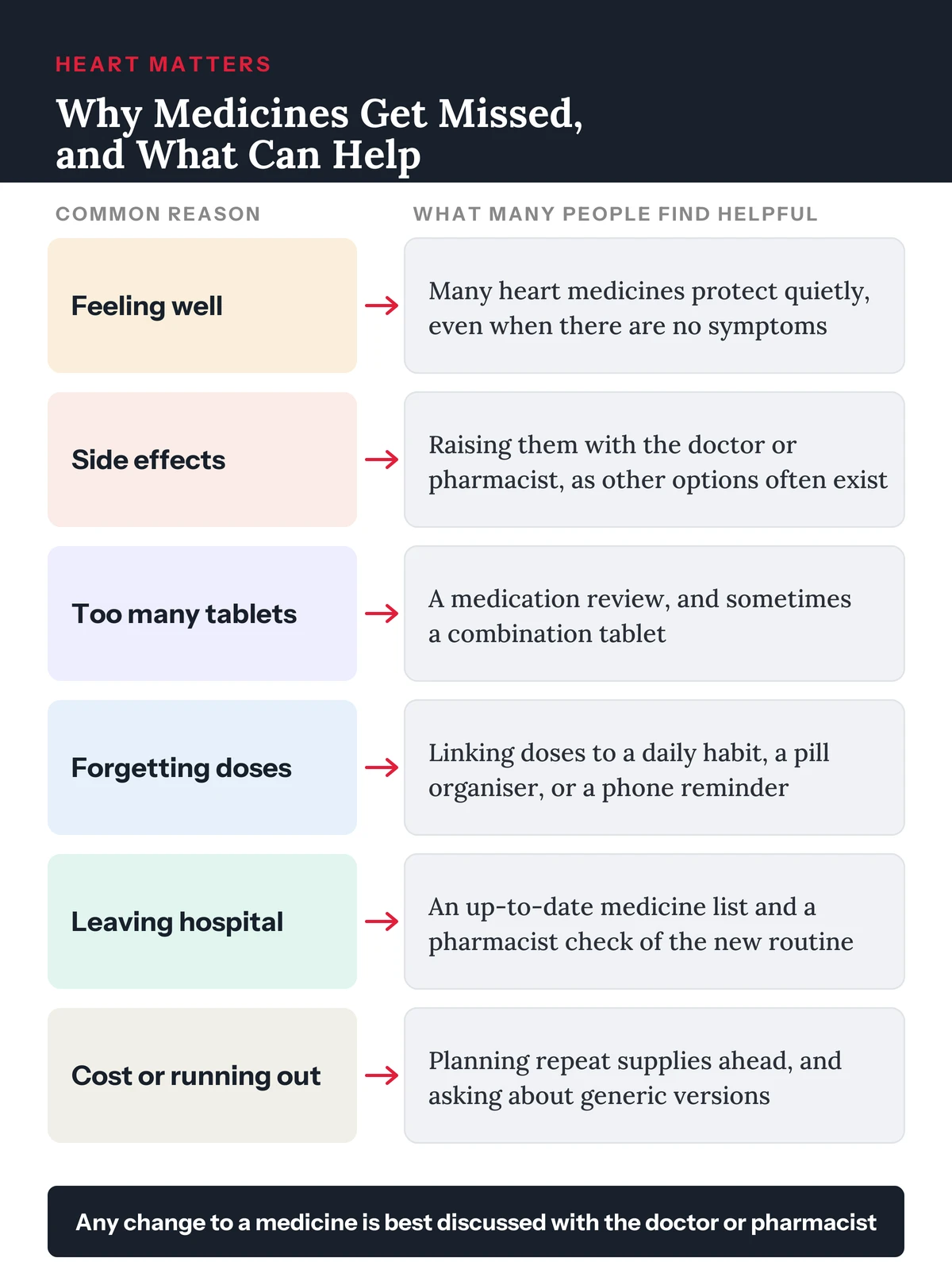
The reasons are usually practical and very human. Feeling well is one of the most common. When there are no symptoms, it is natural to wonder whether a tablet is still needed.
Side effects are another. A dry cough on an ACE inhibitor, tiredness on a beta-blocker, or muscle aches that may or may not be related to a statin can all make people reluctant to keep going.
Other common reasons include:
- A long list of tablets taken at different times of day.
- Changes to medicines after a hospital stay that are not fully explained.
- The cost of several medicines at once.
- Running out between appointments.
- Worry about taking a medicine for many years, often fuelled by stories online or from friends.
- Forgetting, especially when routines change on holidays or weekends.
Worries about statins come up particularly often. These concerns are understandable and worth talking through openly. The article Statins: What Patients Ask Me Most covers the questions patients raise most frequently.
What Happens When Heart Medicines Are Stopped
Stopping a medicine affects the body in different ways depending on the medicine. For some, the protection simply fades. For others, stopping suddenly can cause a rebound effect.
Antiplatelet medicines, such as aspirin, clopidogrel, and ticagrelor, prevent platelets from sticking together. When they are stopped, platelets become sticky again within days. After a stent, this raises the risk of a clot forming inside the stent, which can cause a heart attack. This is why the length of antiplatelet treatment is planned carefully, and why any pause around surgery or dental work is usually coordinated with the cardiologist. Whether, when, and how to stop is a decision for the prescribing doctor.
Beta-blockers slow the heart and reduce its workload. When they are stopped abruptly, the heart can speed up and become more sensitive to adrenaline, which may bring on palpitations, chest pain, or a rise in blood pressure. This is why the dose is usually reduced in stages rather than halted outright. There are some situations where a doctor may stop a beta-blocker straight away, and the decision rests with the prescribing doctor.
Statins and blood pressure medicines do not usually cause a sudden rebound, but their protective effect wears off over time once they are stopped. Cholesterol and blood pressure tend to drift back towards their earlier levels.
Practical Approaches Many People Find Helpful
There is no single system that suits everyone. The approaches below are ones that many people use, and the best choice depends on the person, their routine, and their medicines.
Linking doses to a daily habit
Tying a dose to something that already happens every day, such as breakfast, brushing teeth, or the evening news, is one of the most commonly used strategies. The habit acts as the reminder.
Pill organisers and blister packs
A weekly pill organiser with compartments for each day makes it easy to see whether a dose has been taken. Many pharmacies can also prepare medicines in sealed blister packs or sachets, sorted by day and time. These can be especially useful for people on several medicines, or for carers helping someone else.
Reminders
Phone alarms and medication reminder apps help some people, particularly when routines change. Others find a note on the fridge or a family member’s prompt works better.
An up-to-date medicine list
A written list of every medicine, including the dose and what it is for, is useful at every appointment and in an emergency. It is particularly valuable after a hospital stay, when medicines are often added, stopped, or changed. Many people keep a copy in their wallet or on their phone.
Planning repeat supplies
Running out is a common and avoidable reason for missed doses. Checking supplies a little ahead of time, and arranging repeat prescriptions before the last packet, helps keep treatment continuous.
Timing, Food, and Fitting Medicines Into the Day
Some medicines come with general guidance about when or how to take them. The details vary between medicines and between people, so the pharmacist or prescribing doctor is the best source of advice on any individual routine. Some common examples:
- Aspirin is often taken with or after food, which can reduce stomach upset.
- Fluid tablets (diuretics) are usually taken earlier in the day, so that extra trips to the toilet are less likely to disturb sleep.
- For many statins, taking them consistently matters more than the exact time of day. The article on timing cholesterol-lowering medicines explains this in more detail.
- For blood pressure medicines, a large trial of more than 21,000 people found no difference in heart attacks, strokes, or heart-related deaths between morning and evening dosing.
For most people, the best time to take a medicine is the time that fits their routine and is easiest to remember. Consistency usually matters more than the clock.
What About Missed Doses?
Almost everyone misses a dose at some point. What to do next depends on the medicine, how often it is taken, and how much time has passed. For some medicines, the missed dose is taken as soon as it is remembered. For others, it is skipped and the usual schedule continues. Doubling up is generally not recommended without advice.
Because the answer differs between medicines, a pharmacist or the prescribing doctor is the right person to ask. Many people find it helpful to ask this question once for each medicine, so they know in advance.
The Pharmacist’s Role
Pharmacists are often the most accessible health professionals, and their knowledge of medicines is extensive. They can explain what each medicine is for, check for interactions, and help with practical questions about timing, food, and missed doses.
Many pharmacies also offer a structured medication review. This involves looking across the whole list of medicines, including vitamins, supplements, and over-the-counter products, to make sure everything still makes sense together. Some things that seem unrelated, such as certain anti-inflammatory painkillers or cold and flu tablets, can affect blood pressure or interact with heart medicines.
Simplifying the Routine
A routine that is simpler is usually easier to keep. Doctors and pharmacists can often help with this in several ways:
- Reviewing whether every medicine is still needed.
- Moving doses to the same time of day where that is safe and suitable.
- Using a combination tablet that contains two medicines in one.
A “polypill” takes this idea further by combining several heart medicines in a single tablet. In a large trial of older adults after a heart attack, a polypill containing aspirin, ramipril (an ACE inhibitor), and atorvastatin (a statin) improved how consistently people took their treatment. It also led to fewer major heart events compared with taking the same medicines separately. Polypills and combination tablets are not available everywhere, and they are not suitable for everyone, but they show how much a simpler routine can matter.
The best medicine routine is one that fits real life. If a routine is hard to follow, that is worth raising, because it can often be changed.
Side Effects and Worries Are Worth Raising
Quietly stopping a medicine because of a side effect or a worry is very common. Yet in many cases there is another option: a lower dose, a different medicine in the same family, or a change in timing. The ACE inhibitor cough is a good example, as switching to a related medicine called an angiotensin receptor blocker is a well-established solution for many people.
Doctors and pharmacists generally find it far more helpful to hear about a problem than to discover later that a medicine was stopped. An honest conversation is how a treatment plan gets adjusted to suit the person taking it.
For people who have recently had a heart event, the article on recovering after a heart attack explains how medicines fit into the wider picture of recovery.
Conclusion
Heart medicines protect quietly, and that protection depends on taking them consistently. Missing or stopping medicines is common, and the reasons are usually understandable: feeling well, side effects, complicated routines, cost, or simply forgetting.
Small supports such as routines, pill organisers, and an up-to-date medicine list help many people. Equally important is an open conversation with the pharmacist and doctor, who can often simplify a routine, answer questions about timing and missed doses, and find an alternative when a medicine is not agreeing with someone.