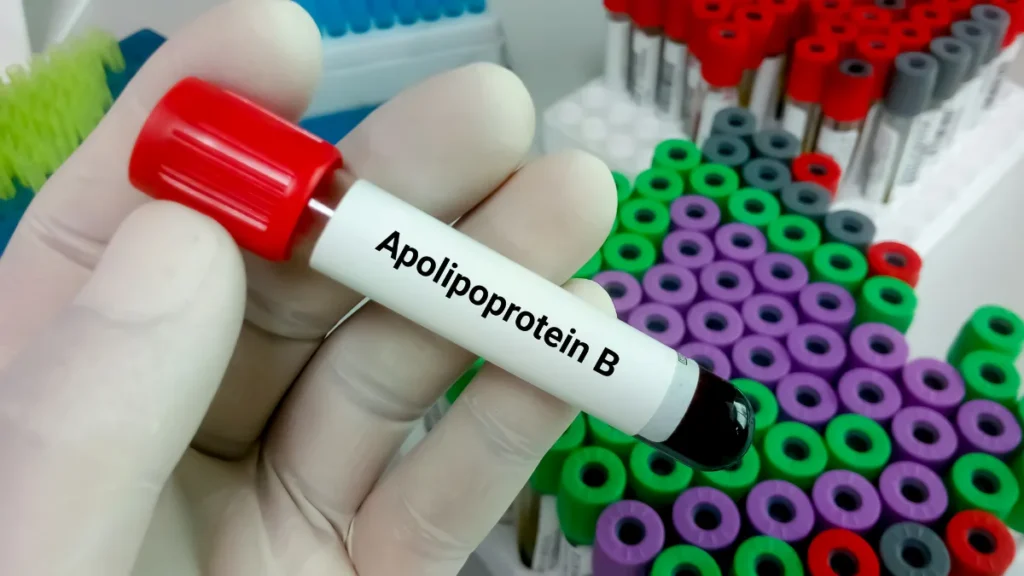
- ApoB is a single protein that sits on the surface of every cholesterol particle capable of causing plaque, so an apoB result is effectively a headcount of all the particles that can harm your arteries.
- A standard LDL cholesterol result measures the cholesterol carried inside your particles, not how many particles there are. Most of the time the two agree, but in some people they do not.
- When LDL cholesterol looks reassuring but apoB is high, this mismatch (called discordance) can reveal hidden risk that a routine cholesterol panel misses.
- Strong evidence supports apoB as an accurate marker of cardiovascular risk, particularly in people with high triglycerides, type 2 diabetes, or metabolic syndrome.
- ApoB does not replace your LDL, triglycerides, or lipoprotein(a) results. Each tells you something the others cannot, and the best assessment uses them together.
- No single number captures your risk. Heart disease is multifactorial, so blood pressure, diabetes, smoking, weight, and family history all matter alongside your lipids. Investigations such as a calcium score add another layer, and whether to add apoB is a conversation worth having with your cardiologist.
There is a lively and sometimes heated debate online about cholesterol. One vocal group argues that the LDL cholesterol number most of us have measured for decades is almost beside the point, and that a different number, apolipoprotein B, or apoB, is the one that truly predicts heart disease. If you have come across this argument and felt unsure who to believe, you are not alone.
The truth, as is so often the case in medicine, sits between the two extremes. ApoB is a genuinely valuable measurement, and the science behind it is sound. It is also not a magic number that makes everything else obsolete. This article explains what apoB actually is, why it can outperform a standard cholesterol result, and how to think about whether it belongs in your own blood tests.
What Is ApoB, Exactly?
To understand apoB, it helps to picture how cholesterol travels through your blood. Cholesterol is a fatty substance, and fat does not dissolve in water. So your body packages cholesterol inside tiny spherical particles that can move through the bloodstream. The particles that drive atherosclerosis, the gradual furring of the arteries, include LDL (low density lipoprotein) and a few close relatives.
Here is the key fact. Every one of these harmful particles carries exactly one molecule of a protein called apolipoprotein B on its surface. One particle, one apoB. This includes LDL, VLDL, IDL, and even lipoprotein(a). So when a laboratory measures your apoB level, it is effectively counting the total number of particles in your blood that are capable of lodging in your artery wall and forming plaque.
Why Counting Particles Can Beat Measuring Cholesterol
A standard lipid panel reports your LDL cholesterol, which sounds like it should tell you everything. But LDL cholesterol measures the amount of cholesterol carried inside your LDL particles. It does not measure how many particles you have.
This distinction matters because particles vary in size. Some people carry a smaller number of large, cholesterol-rich particles. Others carry a large number of small, cholesterol-poor particles. Two people can have an identical LDL cholesterol result while one has far more circulating particles than the other. Since it is the particles themselves that burrow into the artery wall, the person with more particles carries more risk, even though their cholesterol number looks the same.
A useful way to picture it: imagine traffic on a motorway. LDL cholesterol tells you the total weight of cargo being carried. ApoB tells you how many vehicles are on the road. If your arteries are the road, it is the number of vehicles, not the total cargo, that determines how often something collides with the wall.
One protein per particle
Every harmful cholesterol particle carries a single apoB protein, so your apoB level counts every particle that can cause plaque.
Cargo versus headcount
LDL cholesterol measures the cargo carried inside particles. ApoB counts the particles themselves, which is what damages the artery wall.
Why the gap matters
When particle count is high but cholesterol per particle is low, your LDL result can look fine while your true risk is not.
The family of particles apoB counts
ApoB does not just count LDL. It tags several related particles, each of which can contribute to plaque. This is part of why a single apoB result can be so informative: it captures the whole atherogenic family in one number.
LDL
Low density lipoprotein. The most familiar and most numerous of the harmful particles, and the main driver of plaque in most people.
VLDL and IDL
Larger, triglyceride-rich particles and their remnants. They become more important when triglycerides are high.
Lipoprotein(a)
An LDL-like particle with an extra protein attached. Largely inherited, and counted within apoB but not separately identified by it.
Each of these carries one apoB protein, so they are all captured in your total. What apoB cannot do is tell you the breakdown. It will not reveal, for instance, whether a high count is driven by ordinary LDL or by an inherited excess of Lp(a). That is one reason the individual tests retain their value, a point we return to below.
When LDL Cholesterol and ApoB Disagree
Most of the time, your LDL cholesterol and your apoB tell the same story. When both are high, or both are low, doctors call this concordance, and a standard cholesterol panel serves you perfectly well.
The interesting and clinically important situations are the mismatches, known as discordance. This is when your LDL cholesterol looks acceptable but your apoB is high, signalling many small particles quietly carrying on their work. In this scenario, a reassuring cholesterol result can give false comfort. A large 2024 review of 15 studies involving nearly 600,000 people found that apoB was a more accurate marker of risk than LDL cholesterol in every discordance study examined.
Who is most likely to be discordant
You are more likely to have a meaningful gap between your LDL cholesterol and your apoB if you have any of the following: high triglycerides, type 2 diabetes, metabolic syndrome, central weight gain around the abdomen, or a pattern of small dense LDL particles. People in these groups can have a deceptively normal LDL cholesterol while their particle count, and their risk, runs higher. This is precisely the group in which apoB adds the most.
What the Evidence Actually Shows
The case for apoB is strong, and it is worth being clear about what the research does and does not say.
On the supportive side, apoB has performed consistently well as a predictor of heart attack and stroke, often edging out both LDL cholesterol and non-HDL cholesterol, particularly in people whose results are discordant. Because it counts particles directly, it is less affected by the variations in particle size that can distort a standard cholesterol reading. For people with diabetes or high triglycerides, this advantage is most pronounced.
On the cautious side, this does not mean LDL cholesterol is worthless. Far from it. Lowering LDL cholesterol remains the single most trial-tested intervention in all of preventive cardiology. Decades of randomised trials, including the trials that established statins and newer agents such as PCSK9 inhibitors, were built on LDL cholesterol as the target, and the benefit of lowering it is beyond dispute. The online voices declaring LDL cholesterol irrelevant overstate the case considerably.
Why LDL, Triglycerides, and Lp(a) Still Matter
The enthusiasm for apoB has, in some corners of the internet, tipped into dismissing the numbers we have relied on for years. That is a mistake. Each of the established measurements tells you something apoB alone does not, and a good lipid assessment uses them together.
LDL cholesterol
LDL cholesterol is not a flawed or outdated number. It is the most thoroughly validated treatment target in cardiology, and every major guideline still places it at the centre of care. The reason is simple: when we lower LDL cholesterol in clinical trials, heart attacks and strokes fall in proportion, reliably and repeatedly. ApoB refines how we interpret LDL cholesterol in certain people. It does not unseat it. If you are tracking one number over time to see whether your treatment is working, LDL cholesterol remains an entirely sensible choice.
Triglycerides
Triglycerides are a separate and valuable piece of the puzzle. A raised triglyceride level is one of the clearest signals that your LDL cholesterol and apoB may be discordant, because high triglycerides tend to accompany the small, dense, numerous particles that apoB picks up. Triglycerides also respond strongly to lifestyle, which makes them a useful and motivating number to watch. Diet matters here, and the evidence supporting the Mediterranean diet and omega-3 fats is particularly relevant for people with elevated triglycerides.
Lipoprotein(a)
Lipoprotein(a), or Lp(a), deserves its own place on the test request entirely. It is largely inherited, it changes very little over a lifetime, and a single measurement tells you whether you carry this extra, independent layer of risk. While apoB does count Lp(a) particles among its total, it cannot tell you how much of your risk comes specifically from Lp(a), which is why a dedicated Lp(a) test remains worthwhile in its own right. For many people this is a once-in-a-lifetime measurement that meaningfully changes how aggressively their other risk factors should be managed.
What Does a Statin Do to Your ApoB?
This is a question worth answering directly, because it is one of the most useful things to understand about apoB in practice. Statins lower apoB substantially, typically by somewhere in the range of a quarter to nearly half, broadly in step with how much they lower LDL cholesterol. Adding ezetimibe or a PCSK9 inhibitor brings it down further still. So if you are already on treatment, your apoB is very likely already falling alongside your other numbers.
There is one important exception, and it is the reason apoB does not make the individual tests redundant. Statins do very little to lipoprotein(a). Someone can take a statin, watch their LDL cholesterol and apoB fall nicely, and still carry a high inherited Lp(a) that the treatment has barely touched. This is exactly why measuring Lp(a) at least once, separately, remains worthwhile even for people whose apoB looks well controlled.
ApoB Is One Piece of a Multifactorial Picture
Perhaps the most important point in this whole discussion is the one the online debate tends to forget. Cardiovascular disease is multifactorial. No single number, however good, captures your risk on its own, and apoB is no exception.
Your overall risk is shaped by a web of factors that interact with one another. These include your blood pressure, whether you have type 2 diabetes or features of metabolic syndrome, whether you smoke, your weight and waist measurement, your family history, your level of inflammation, and your age. A person with a perfect apoB but uncontrolled blood pressure and a smoking habit is not low risk. Conversely, a moderately raised apoB carries very different weight in an otherwise healthy 45-year-old than in someone with diabetes and a strong family history.
This is why fixating on any one marker, apoB included, can be misleading. The most useful approach is the one your cardiologist actually uses: weighing your lipids alongside every other modifiable factor. Two of the most powerful of those, smoking and high blood pressure, are entirely separate from your cholesterol particles and yet enormously important. You can read a fuller account in our overview of cardiovascular risk factors.
The Role of Investigations
Blood markers tell you about risk. Imaging can tell you what is actually happening in your arteries, and the two together are far more informative than either alone.
The coronary calcium score is the investigation patients most often ask about, and it can be confusing, so it is worth being clear. A calcium score does not measure your cholesterol or your particle count. It measures calcified plaque that has already formed in your coronary arteries, giving a direct picture of the disease itself rather than the risk factors driving it. A high score can prompt more intensive treatment even when your blood results look reasonable. Our article on what a high calcium score really means explains how to interpret the number.
One genuine source of confusion deserves a mention. Because statins can convert soft plaque into denser, calcified plaque, people on a statin can sometimes see their calcium score rise even as their risk falls. This apparent paradox is explained in our piece on statins and your calcium score. For people who need a more detailed look at the arteries themselves, a CT coronary angiogram can show both calcified and soft plaque. Inflammation markers such as hs-CRP can add yet another dimension. Which of these, if any, is right for you depends entirely on your circumstances and is a decision for you and your cardiologist.
Where the Guidelines Stand
The official guidance reflects this balanced reality. Different expert bodies place apoB at slightly different points on the spectrum, but none has discarded LDL cholesterol.
| Guideline body | Position on apoB |
|---|---|
| European (ESC/EAS) | Accepts apoB as an alternative to LDL cholesterol for risk assessment. The 2025 update still confirms LDL cholesterol as the primary target. |
| Canadian (CCS) | The most apoB-forward. Allows apoB to be used as the primary therapeutic target, especially when triglycerides are raised. |
| United States (ACC/AHA) | Lists a high apoB as a risk-enhancing factor that supports more intensive treatment, but does not yet set a routine apoB target. |
| National Lipid Association | Proposes graded apoB targets that become stricter as cardiovascular risk rises. |
The main reason apoB has not yet replaced LDL cholesterol everywhere is not weak evidence. It is the absence of a single agreed target across all guidelines, combined with a degree of caution about changing long-established practice. Availability and cost also vary from one health system to another.
Should You Add ApoB to Your Next Blood Test?
In Australia, apoB can be measured by most pathology laboratories, usually reported in grams per litre. It is not always part of a standard lipid panel and may not be routinely rebated, so it is worth asking whether it applies to your situation and whether there is an out of pocket cost.
There is a strong argument for measuring apoB at least once if you fall into a higher-risk group, particularly if you have raised triglycerides, type 2 diabetes, metabolic syndrome, or a family history of early heart disease. It is also useful when your LDL cholesterol seems well controlled but you or your cardiologist remain concerned about residual risk. For someone already tracking LDL, HDL, and lipoprotein(a), as many thoughtful patients now do, apoB is a natural and informative addition rather than a replacement for any of them.
What apoB cannot do is stand alone. It works best alongside your other blood results, any imaging you have had, and the broader picture of your risk factors. The number is only as useful as the conversation it prompts with the person managing your care.
Heart Matters Resource
When in Doubt, Get Checked Out
If you are unsure whether your cholesterol results tell the full story, a focused review of your numbers with your GP or cardiologist is one of the most worthwhile conversations you can have.
Conclusion
ApoB is one of the most useful advances in everyday cardiovascular risk assessment, because it counts the particles that actually cause plaque rather than estimating the cholesterol they carry. For people whose standard cholesterol result may be quietly misleading, it can uncover risk that would otherwise go unnoticed.
The balanced takeaway is this. LDL cholesterol, triglycerides, and lipoprotein(a) each remain valuable, and apoB sharpens the picture rather than replacing any of them. None of these numbers stands alone, because heart disease is multifactorial: your blood pressure, diabetes, smoking status, weight, and family history all matter alongside your lipids. The most useful conversation you can have is not about a single number, but about the whole picture, with the cardiologist who knows your circumstances.
Related Reading
- Lipoprotein(a): The Inherited Heart Risk Most People Have Never Heard Of
- Understanding Your Cardiovascular Risk Factors
- The Coronary Calcium Score: What It Measures and What to Expect
- Statins and Your Calcium Score: Understanding the Paradox
- Statins: What Patients Ask Me Most
- High Blood Pressure: Why Monitoring Matters and What Your Numbers Mean
- Smoking and Your Heart: Understanding the Risks