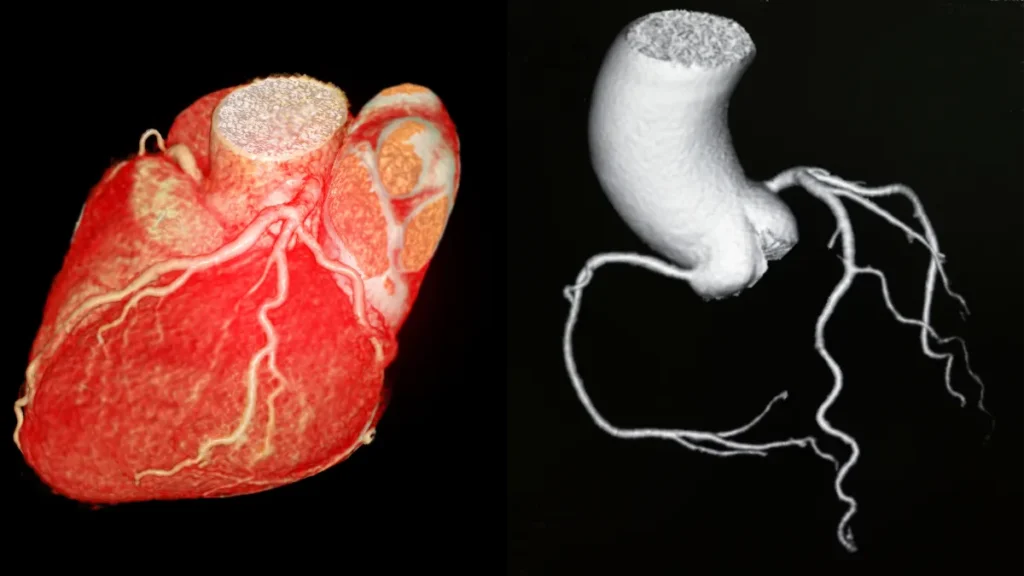
- A CT coronary angiogram (CTCA) is a non-invasive scan that produces detailed three-dimensional images of the coronary arteries, using a CT scanner, a small cannula in the arm, and an iodine-based contrast dye.
- It is one of several tools your cardiologist can choose from, and is particularly useful in people with chest pain or breathlessness where the likelihood of coronary disease is low to intermediate.
- Heart rate control matters for image quality. Avoid caffeine for 12 to 24 hours beforehand, and a beta-blocker tablet may be prescribed for the morning of the scan.
- The scan uses X-ray radiation. Modern scanners have reduced the dose substantially, with a typical study around one to three years of natural background exposure, but it remains a real exposure that is weighed against the value of the information the scan provides.
- A normal CTCA provides strong reassurance that the coronary arteries are free of significant blockages. If disease is found, the scan helps guide what happens next.
A CT coronary angiogram, often shortened to CTCA, is one of several ways your cardiologist may look at the coronary arteries when symptoms such as chest pain or breathlessness need investigating. It uses a CT scanner, a small cannula in a vein, and an iodine-based contrast dye to produce detailed three-dimensional images of the arteries that supply the heart muscle with blood.
CTCA sits in a useful middle ground among the available heart tests. It produces highly detailed images without needing a catheter, sedation, or an overnight stay, but it has its own limitations and is not the right test for everyone. Whether it is the most useful investigation in your case is a decision your cardiologist will make alongside you.
If you have been referred for a CTCA, what follows is a clear walk through what the scan involves, what it can and cannot show, and how to prepare.
What to Expect, CT Coronary Angiogram
Duration
30 to 45 minutes total. Breath-hold is 10 to 15 seconds.
Before
No caffeine for 12 to 24 hours. Fast for four to six hours.
During
Painless. Cannula in the arm. Brief warm flush from the dye.
Dose
Uses X-ray radiation, around one to three years of background. Iodine contrast used.
Results
Reported by a specialist within a few days to a week.
After
No restrictions. Drink water to clear the contrast.
What Does a CTCA Show?
The coronary arteries in detail
The scan generates cross-sectional and three-dimensional images of the coronary arteries, the three main vessels that supply oxygenated blood to the heart muscle. It can identify atherosclerotic plaque within the artery walls, including both calcified (hard, dense) plaque and non-calcified (softer, lipid-rich) plaque.
CTCA can detect narrowings within the coronary arteries ranging from mild to severe. A normal scan provides strong reassurance that there is no significant blockage. Where disease is present, the scan helps quantify how much and where, which is what informs the conversation about what comes next.
What else it can assess
CTCA can assess bypass grafts in people who have had prior coronary surgery, and is sometimes used to help plan more complex interventional procedures. It can also be combined with a coronary calcium score in the same session, providing both a numerical measure of calcified plaque burden and the more detailed anatomical imaging of the CTCA.
Who Is It For?
CTCA is most useful in people with a low to intermediate likelihood of significant coronary disease. This typically includes those with chest pain, chest tightness, or breathlessness on exertion where the diagnosis is uncertain, and those in whom a non-invasive alternative to an invasive angiogram is being considered.
It is less useful in some situations. People with very high pre-test probability of severe disease are often better served by going directly to invasive angiography, which has the advantage of being able to treat significant disease in the same session. Heavy coronary calcium can obscure the inside of the artery on a CT scan. Atrial fibrillation with an irregular or fast heart rate can degrade image quality. In each of these settings, your cardiologist may recommend a different test.
The choice of which heart investigation is right for which person is always a clinical judgement, made after weighing symptoms, risk factors, prior testing, and what the result of each test would actually change.
A word on radiation
Like every CT scan, a CTCA uses ionising radiation. This is one of the considerations that goes into deciding whether it is the right test. The dose has come down considerably over the past decade as scanner technology has improved, and a typical study now delivers an exposure roughly equivalent to one to three years of natural background radiation. The exact dose depends on the scanner, the protocol, and the patient.
The risk associated with this kind of one-off exposure is small, but it is not zero, which is part of why CTCA is used selectively rather than as a screening test. For people with symptoms that warrant investigation, the diagnostic information gained almost always outweighs this risk. For people without symptoms or with a very low likelihood of disease, a different approach (such as a calcium score or no imaging at all) is often more appropriate.
Preparing for the Scan
Why preparation matters
Preparation is important for CTCA, and is not a formality. The heart beats continuously, and capturing clear images of the coronary arteries requires a low, stable heart rate to reduce motion blur. An elevated heart rate is the most common cause of suboptimal image quality.
What to do before the scan
Avoid caffeine for at least 12 to 24 hours beforehand. Coffee, tea, energy drinks, and chocolate all count. The effect of caffeine on heart rate lasts longer than most people expect.
Avoid strenuous exercise on the day of the scan. Take your regular medications as normal unless specifically told otherwise.
Many centres pre-prescribe a beta-blocker tablet, typically taken the evening before and again on the morning of the scan, to bring the resting heart rate to a level suitable for imaging (usually below 65 beats per minute). Your specific instructions will come from the referring team or the imaging centre.
Fasting and contrast considerations
Most centres ask for no food or drink (except water) for four to six hours before the scan. If you have a history of contrast dye allergy or impaired kidney function, let the imaging team know in advance. Blood tests and a pre-medication protocol can be arranged where needed.
During the Scan
What happens step by step
On arrival, a nurse inserts a small cannula into a vein in the forearm and places ECG leads on the chest to monitor heart rhythm throughout. You lie on the scanner bed and move into the scanner ring. The scanner is open and ring-shaped, not a long enclosed tunnel.
Just before imaging, a small dose of glyceryl trinitrate (GTN) spray is given under the tongue. This briefly widens the coronary arteries to make them easier to see, and is standard practice at most centres.
The contrast dye is then injected through the cannula, and you hold your breath for 10 to 15 seconds while the images are captured. You may feel a warm flushing sensation spreading through your body. This is entirely normal, passes quickly, and is not an allergic reaction. The active scanning takes well under a minute.
Limitations to Be Aware Of
When CTCA works less well
Heavy coronary calcium can create artefacts that obscure the degree of any underlying narrowing, making it difficult to tell severe disease apart from apparent blockage on the images alone. Coronary stents similarly create metallic artefacts that limit assessment of the inside of the stent itself, although the rest of the coronary tree can usually be seen.
A fast or irregular heart rate, particularly from atrial fibrillation, degrades image quality. In these settings, an alternative investigation is often preferred. These limitations are part of why CTCA is not chosen for everyone, and why the question of what test best fits each person is a careful clinical decision.
How CTCA Sits Among the Other Heart Tests
CTCA is one of several investigations available for the assessment of coronary artery disease. Each has its place, and the right choice depends on the individual.
The coronary calcium score is a simpler, quicker, lower-radiation scan that measures the burden of calcified plaque without contrast. It is more often used for risk stratification in people without symptoms than as a symptom investigation.
A stress echocardiogram or nuclear stress test takes a different approach. These look at how the heart functions under the stress of exercise or a medication that mimics it, and assess whether any existing narrowings are causing a problem with blood flow during exertion.
Invasive coronary angiography remains the most detailed anatomical view of the coronary arteries, and has the advantage that any significant narrowing found can be treated in the same session with a stent. It is more invasive than CTCA, requires a catheter through the wrist or groin, and usually involves an outpatient stay for recovery and observation.
Scanner technology has continued to evolve, with newer generations offering improved image quality at lower radiation doses than older protocols, including in people with significant coronary calcium or stents. Availability varies between centres. The imaging team will use whichever scanner is available to them and most suitable for your scan.
- Am I a good candidate for CTCA, or would a different investigation suit my situation better?
- Should I have a coronary calcium score done at the same time?
- Do I need a beta-blocker prescription before the scan, and when should I take it?
- My heart rhythm is irregular. Does this affect whether CTCA is suitable for me?
- If the scan shows a narrowing, what would the next step be?
Heart Matters Resource
When in Doubt, Get Checked Out
Chest tightness, pressure, or breathlessness on exertion that is new or worsening deserves prompt assessment. Whether the right next step is a CTCA, a stress test, or a different investigation is a decision for your cardiologist.
Conclusion
A CT coronary angiogram is one of several well-tolerated, non-invasive options available for assessing the coronary arteries. For the right person, it provides clear answers in a single outpatient visit. For others, a different investigation may be a better fit.
Preparation matters, particularly heart rate control, and understanding what the scan involves takes most of the uncertainty out of what is, in practice, a straightforward procedure. The result of any heart test sits within a broader conversation about symptoms, risk factors, and what comes next. That conversation belongs with your cardiologist.
Related Reading
- Understanding the Coronary Calcium Score
- The Stress Echocardiogram: What to Expect
- The Nuclear Stress Test: What It Is and Why It’s Requested
- Recovering After a Coronary Angiogram
- The Echocardiogram: What It Shows and Why It Matters
- What Is Atherosclerosis?
- Understanding Your Cardiovascular Risk Factors