- A heart attack happens when a clot blocks an artery supplying the heart. Whatever else follows, that artery has to be opened, and quickly.
- In a large hospital this is done with a thin tube passed up to the heart, then a balloon and a stent. In a hospital without that facility, the first step is a drug given into a vein that dissolves the clot.
- The drug is not a second-rate substitute. When the specialist hospital is more than about two hours away, it opens the artery sooner than the journey would, and sooner is what counts.
- The main risk is bleeding, including bleeding into the brain. It is uncommon, but it is the reason your medical team runs through a careful list of questions before giving it.
- Almost everyone who receives the drug is still transferred afterwards. Dissolving the clot does not repair the narrowing underneath that caused it.
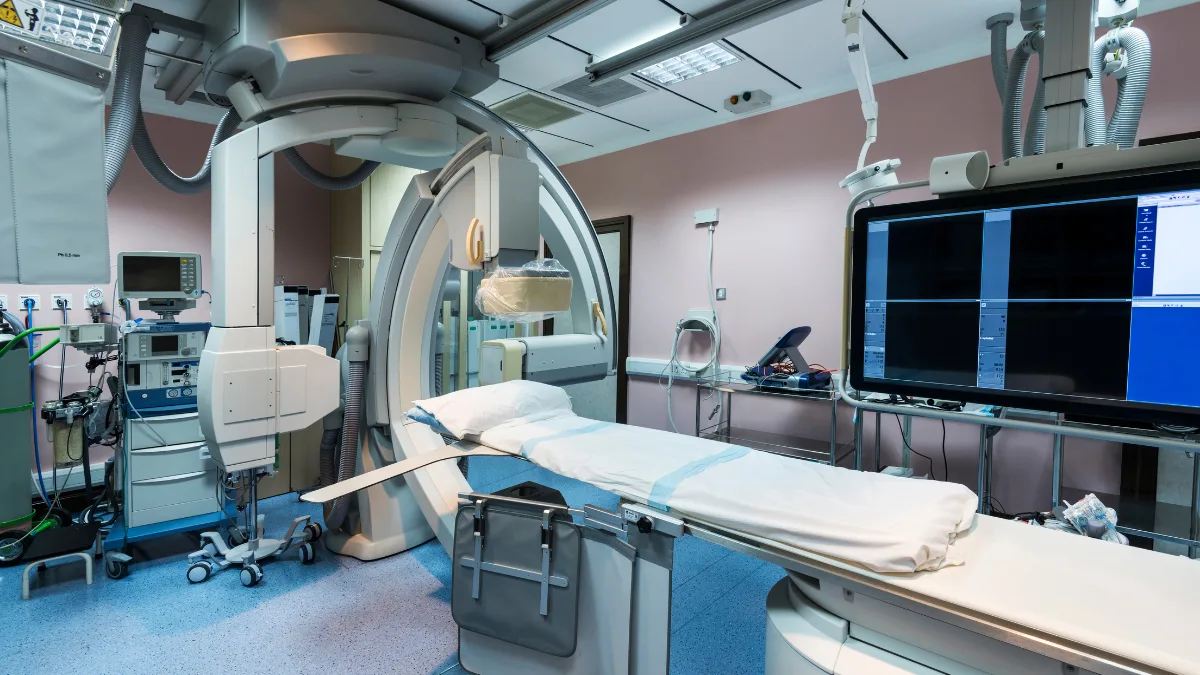
Part of my work as a Cardiologist takes me to Swan Hill, a town on the Murray River in Victoria, Australia. It is almost a five-hour drive from Melbourne, and I do that drive both ways. The hospital there is a good one, with excellent staff. What it does not have, and what most towns of its size anywhere in the world do not have, is a catheter laboratory: the room where a blocked heart artery can be reopened using a fine tube passed up from the wrist or groin.
So when someone arrives there in the middle of a heart attack, a conversation starts almost immediately between the local team, the retrieval service, and a cardiologist somewhere else. Patients can be flown rather than driven, and retrieval teams are quick and well practised. Even so, the transfer takes time, and heart muscle is at risk while it happens. Do we move this person, or treat them here and move them afterwards?
Millions of people live somewhere that conversation would need to happen. It is worth understanding how it is resolved, because the answer is more reassuring than most people expect.
What Is Actually Happening in a Heart Attack
The heart is a muscle, and like every muscle it needs its own blood supply. Three main arteries sit on its surface and feed it.
Over years, fatty deposits can build up in the wall of one of those arteries. Most of the time they sit there quietly. A heart attack begins when the surface of one of these deposits ruptures. Your body reacts the way it reacts to any injury, by forming a clot to seal it. If that clot fills the artery completely, blood stops flowing.
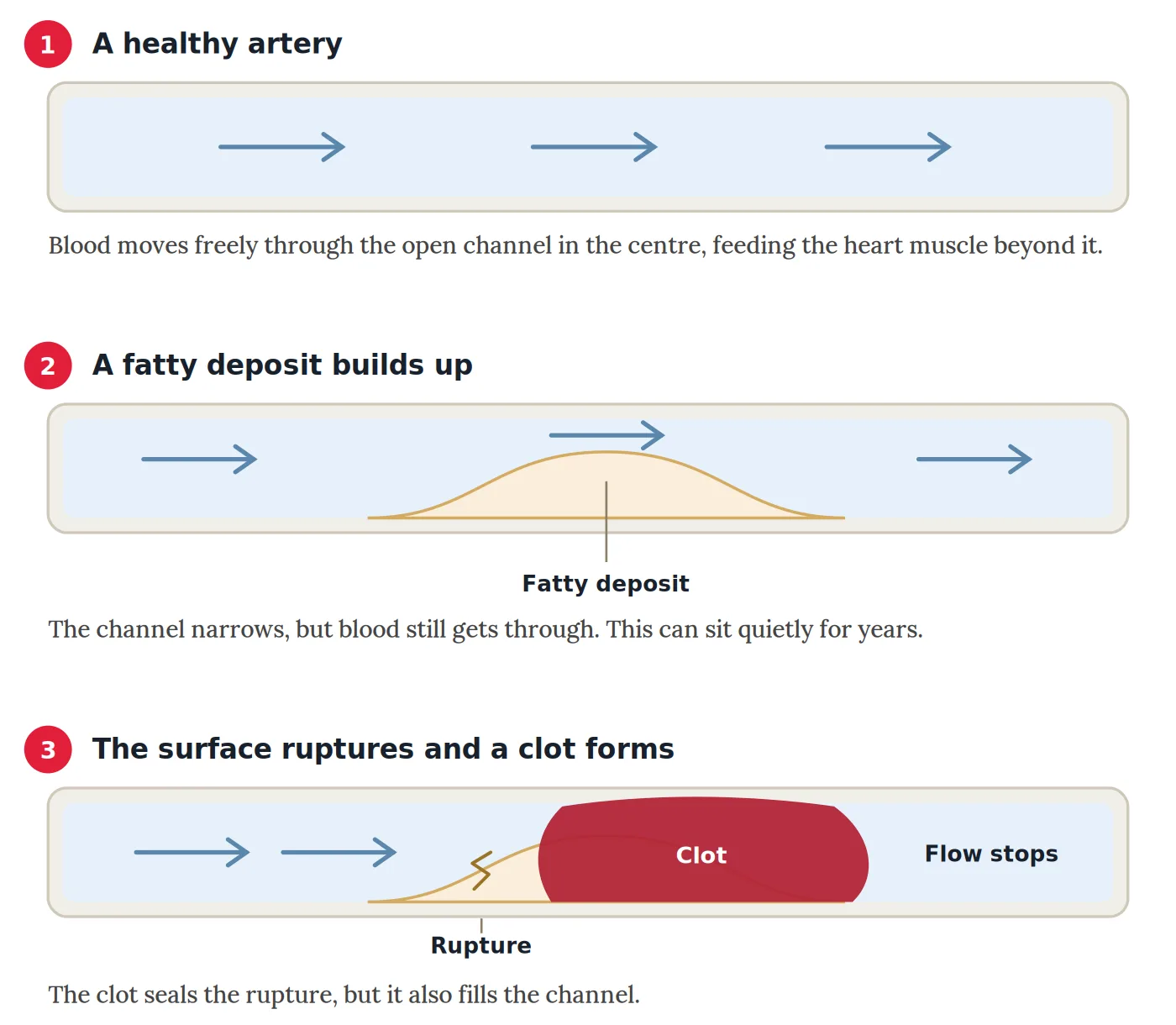
Beyond the blockage, that stretch of muscle is cut off from its supply. How much of it comes through depends almost entirely on how quickly the artery is reopened. Restore the flow early and most of the muscle is preserved. Leave it several hours and less of it is. That is the whole reason for the urgency.
An ECG, the tracing taken from stickers on your chest, shows this pattern clearly within minutes. Doctors have a name for it, a STEMI, and you may see that word on your discharge letter. All it means is that an artery is completely blocked and the clock is running.
Two Ways to Open the Artery
The first way is mechanical. A cardiologist passes a fine tube from the wrist or groin up to the heart, finds the blockage, pushes a small balloon through it, and usually leaves a stent behind to hold it open. This is angioplasty. Where it can be done promptly, it is the better option.
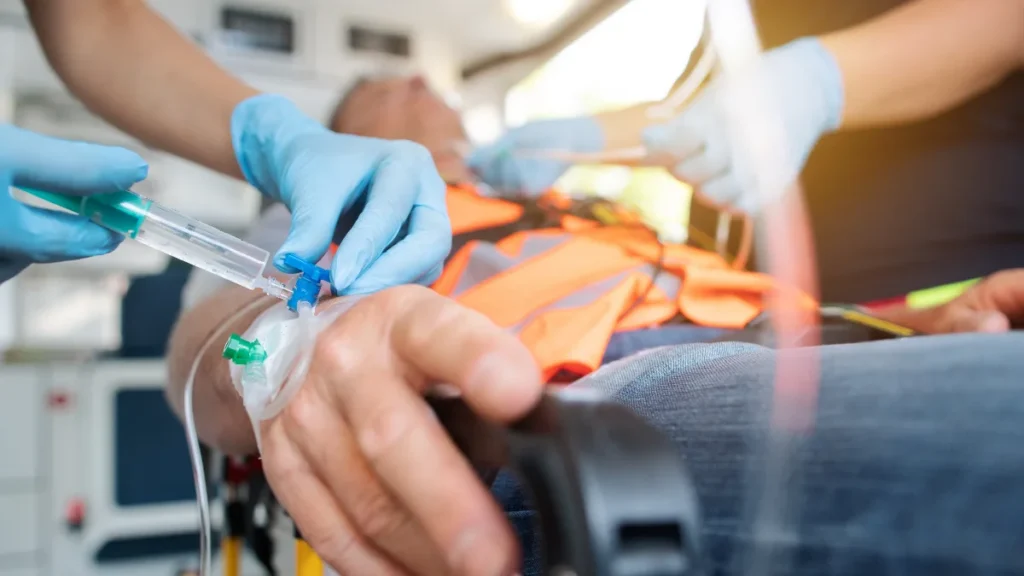
The second way is chemical. A drug goes into a vein and dissolves the clot from the inside. These are the medicines most people know as clot-busters, and they require no special equipment, no cardiologist, and no operating theatre. They can be given in a small emergency department, in an ambulance, or in the back of an aircraft.
Which one a person receives is decided by the clock, not by the quality of the hospital they happen to be standing in.
Where the Clot-Busting Drugs Came From
For most of the twentieth century, doctors believed the clot in a heart attack formed after the muscle died rather than causing it. Dissolving it therefore looked pointless. That view held into the 1970s.
When it was finally overturned, the first drug tested properly was streptokinase, made from a protein produced by bacteria. In 1986 an Italian study of nearly 12,000 patients found it cut deaths by around a fifth. Two years later, a second large study showed that streptokinase helped, that plain aspirin helped, and that giving both together helped considerably more than either alone.
I would put those two studies among the handful that genuinely changed cardiology. Before them, a heart attack was something you watched. Afterwards, it was something you could interrupt.
Newer drugs followed through the 1990s, tested in trials involving well over 100,000 people between them. The differences between the drugs turned out to be small. The lesson that mattered was something else entirely.
Forty years of research pointed at the same conclusion. Which drug is used matters far less than how quickly it reaches the patient.
Angioplasty later proved better than drug treatment wherever both were genuinely available, and it became the preferred approach. What it could not do was shorten the road from a country town. That is why the drugs never went away, and why they are still given every week in hospitals like the one I visit.
How the Drug Works
Your blood already carries the tools to dismantle a clot. It keeps them switched off until they are needed, which is sensible, since a permanently active clot-dissolving system would be dangerous.
These drugs simply switch that system on. They do not attack the clot directly. They activate your own machinery, which then breaks apart the mesh of protein strands holding the clot together, and the blockage crumbles.
The older drug, streptokinase, switched the system on everywhere in the body at once. It worked, but it thinned the blood generally and sometimes caused allergic reactions.
The newer drugs, alteplase, reteplase, and tenecteplase, are more targeted. They act mainly where a clot already exists, which makes them safer and more effective, and current guidelines recommend them over the older one.
Tenecteplase has become the most widely used, for a very practical reason. It is a single injection given over about five seconds, rather than a drip running for an hour. In a small hospital preparing to move a patient, or in a helicopter, that difference matters enormously.
The Two-Hour Rule
Guidelines around the world agree on the threshold, which is reassuring given how differently health systems are organised.
If a team can get the artery open with angioplasty within roughly two hours of the moment medical help first reaches the patient, that is the route taken. If they cannot, and the person is within 12 hours of their symptoms starting, and there is no specific reason to avoid it, the drug is given without waiting.
If angioplasty cannot be reached within roughly this window, giving the clot-dissolving drug first is the better option.
European Society of Cardiology and comparable international guidelines
Once that decision is made, the aim is to have the drug running within 30 minutes of arrival, and sooner where possible. Some ambulance and retrieval services now give it before the patient reaches hospital at all.
The benefit is greatest in the first two or three hours after symptoms begin and fades steadily after that. Beyond about 12 hours there is little left to gain, and the balance shifts back towards transferring the person for angioplasty however far away it is.
What We Check Before Giving It
A clot-dissolving drug cannot tell the difference between a clot that is causing a heart attack and a clot somewhere else that is quietly doing something useful. That is the trade-off, and it is why this treatment carries a bleeding risk that angioplasty does not.
The serious concern is bleeding into the brain. It is uncommon, affecting somewhere around one in 100 people treated or fewer, but it can be devastating when it occurs. The risk is higher in older patients, in very small patients, and where blood pressure is high and not yet controlled.
So before giving it, the team works through a set of questions. Some answers rule the drug out completely. These include any previous bleed into the brain, a stroke caused by a blockage within the last six months, a known weakness or tumour in the brain’s blood vessels, major surgery or a serious head injury in the past month, bleeding from the stomach or bowel in the past month, a known bleeding disorder, or a suspected tear in the body’s main artery.
Other answers do not rule it out but change the balance. Advanced age, a recent fall, pregnancy, a stomach ulcer, or blood pressure that is very high all fall into this group, and they are weighed against how large the heart attack is and what the alternative would involve.
Where the drug genuinely cannot be given, the person is transferred for angioplasty no matter how long the journey takes. That decision gets made quickly, and it is one of the reasons the phone call happens early.
Bruising and minor bleeding around drip sites are common and rarely amount to anything.
Why the Journey Still Happens Afterwards
This part surprises people, and it is the single most useful thing to understand about the whole pathway.
The drug dissolves the clot. It does nothing at all to the fatty deposit underneath that ruptured in the first place. That deposit is still there, still narrowing the artery, and still capable of triggering another clot. Opening the artery buys time. It does not finish the job.
For that reason, guidelines say that essentially everyone who receives the drug should still be moved to a hospital with a catheter laboratory, even when the treatment has clearly worked.
The diagnosis
The ECG confirms a blocked artery. The team works out how long it would realistically take to reach a catheter laboratory, usually with the retrieval service already on the phone.
The treatment
If that journey would take more than about two hours, the drug is given, along with aspirin and other medicines that stop the clot reforming.
Checking it worked
Around an hour to 90 minutes later the ECG is repeated. If the pattern has settled substantially, the artery has almost certainly opened. Chest pain usually eases at the same time.
If it did not work
If the artery has stayed blocked, or the person becomes unwell, transfer happens straight away for urgent angioplasty rather than waiting.
The planned transfer
If it did work, transfer still happens, with a coronary angiogram usually done between two and 24 hours later, and a stent placed if one is needed.
That timing was not chosen arbitrarily. Going to the catheter laboratory immediately after the drug was tested and caused more bleeding without extra benefit. Waiting several days risked the artery closing again. Somewhere between a few hours and a day turned out to be the sweet spot.
The Part That Matters Most
Across every study ever done in this area, the factor with the biggest effect on how someone does has never been which drug they got or which hospital they reached.
It has been how long they waited before calling for help.
That gap is measured in hours in most countries. It is the only part of the whole sequence that happens before any doctor, nurse, or paramedic is involved, and it is the part most people underestimate. Someone with chest discomfort at 11pm who decides to see how they feel in the morning has already spent the window in which either treatment works best, whether they live next door to a major hospital or five hours from one.
Delay is longer still when the symptoms do not match the picture people carry in their heads. Women in particular are more likely to present with breathlessness, nausea, or exhaustion rather than crushing chest pain, and are more likely to wait, and to be waited on, as a result.
None of which is a failing on anyone’s part. Chest symptoms are frequently vague, they rarely arrive at a convenient moment, and not wanting to make a fuss is among the most human responses there is. It is worth knowing that ambulance services would far rather be called early and turn out to be unnecessary than be called too late.
When to Call for Emergency Help
Call your local emergency number straight away if any of these occur. Do not drive yourself, and do not wait to see whether it settles.
- Chest pain, pressure, tightness, or heaviness lasting more than 10 to 15 minutes.
- Discomfort spreading into the arm, jaw, neck, back, or upper stomach.
- Sudden breathlessness, a cold sweat, nausea, or feeling faint alongside any of the above.
Symptoms are often less obvious in women, in people with diabetes, and in older adults. Breathlessness or sudden overwhelming tiredness without any chest pain still warrants an emergency call. An ambulance crew can record an ECG on the spot, warn the hospital you are coming, and start treatment on the way, none of which happens if you drive.
Conclusion
Clot-busting treatment is not a lesser version of modern heart attack care. It is the treatment that created modern heart attack care, and in the right circumstances it remains the better of the two options rather than the fallback. A drug given at 40 minutes in a country hospital does more good than a flawless angioplasty four hours later.
What matters most is the early hours rather than the map. And if you are reading this because it has already happened, to you or to someone you love, the thing I would want you to take from it is that being treated a long way from a major centre does not mean you were given second best. I have written elsewhere about what recovery usually involves, and your own cardiologist can fill in what is specific to you. But whatever the past few weeks have looked like, the distance did not decide this, and that is worth holding onto.
Related Reading
- Recovering After a Heart Attack
- Chest Pain: Understanding Symptoms, Causes and Evaluation
- Heartburn or Heart Attack? How to Tell the Difference
- Angina: What It Is, What It Feels Like, and How It’s Treated
- Stents or Bypass Surgery: How Your Heart Team Decides
- Troponin: The Blood Test at the Heart of Chest Pain Assessment
- Understanding Your Cardiovascular Risk Factors