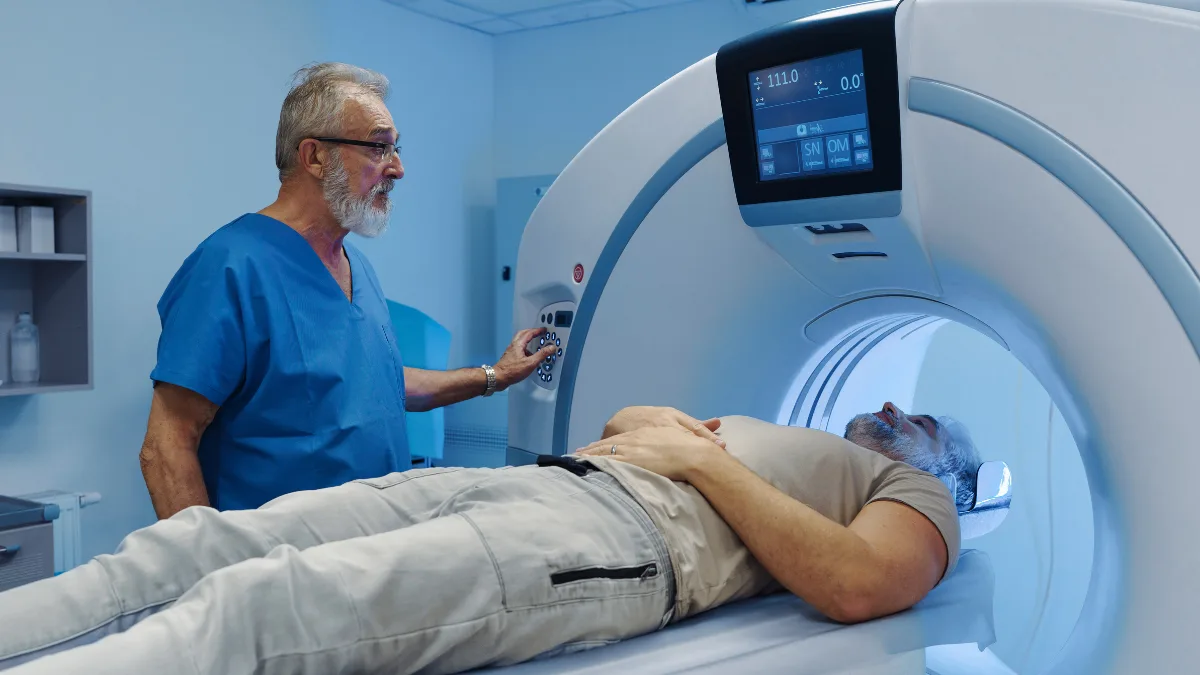

- A nuclear stress test, also called myocardial perfusion imaging (MPI), uses a small amount of radioactive tracer to produce detailed images of blood flow through the heart muscle at rest and during stress.
- It shows not just whether the heart is receiving adequate blood supply, but precisely which areas of muscle are affected and to what degree, making it particularly useful for planning treatment after a heart attack or assessing complex coronary disease.
- The radiation dose is low and the tracer clears from the body within hours. The test is safe and well-tolerated.
- For patients who cannot exercise, a pharmacological stress agent is used to mimic the effect of exertion on the heart, making the test accessible regardless of physical capacity.
- The nuclear stress test is typically requested when other investigations have not provided sufficient information, or when a more detailed map of myocardial perfusion is needed for clinical decision-making.
Most people who are investigated for chest pain or breathlessness will have a stress echocardiogram or CT coronary angiogram as their functional or anatomical assessment. But there is a subset of clinical questions where a more detailed map of blood flow through the heart muscle, not just whether flow is reduced, but precisely where and by how much, changes the clinical decision. That is where myocardial perfusion imaging comes in.
The nuclear stress test is less commonly performed than other cardiac investigations, but when it is requested it is usually for a specific and well-considered reason. Understanding what it involves and what it provides helps patients approach it with appropriate expectations.
What Is a Nuclear Stress Test?
Myocardial perfusion imaging
A nuclear stress test, formally called myocardial perfusion imaging (MPI) or radionuclide stress testing, uses a small amount of a radioactive tracer injected into a vein. This tracer travels through the bloodstream and is taken up by the heart muscle in proportion to blood flow. Areas receiving good blood supply absorb more tracer; areas with reduced flow absorb less.
A specialised camera, called a gamma camera or SPECT scanner, then detects the radiation emitted by the tracer and produces detailed images of the distribution of blood flow through the heart muscle. Images are taken at rest and during stress, and the two sets are compared.
What it can show
Where a stress echocardiogram detects wall motion abnormalities as an indirect consequence of reduced blood flow, myocardial perfusion imaging detects the reduced flow directly. This makes it particularly sensitive for identifying ischaemia, reduced blood supply to the heart muscle during stress, and for mapping its extent and distribution with precision.
It can also distinguish between viable heart muscle that is simply underperfused, and therefore potentially recoverable, and permanently scarred tissue from a previous heart attack that will not recover regardless of intervention. This distinction is clinically important when deciding whether revascularisation is likely to benefit a patient.
When Is It Requested?
The nuclear stress test occupies a specific niche in the cardiac investigation toolkit. It is typically requested in clinical situations where other investigations have not provided sufficient information, or where the level of anatomical and functional detail it provides is specifically needed.
Common indications include assessment of known coronary artery disease where the functional significance of a narrowing needs to be established; evaluation of myocardial viability after heart attack to determine whether revascularisation is likely to improve function; investigation of chest symptoms in patients with complex anatomy, such as previous bypass surgery, where standard stress testing may be less reliable; and risk stratification in patients with known coronary disease prior to non-cardiac surgery.
What to Expect, Nuclear Stress Test
Duration
3–4 hours in total across the appointment, including rest imaging, stress phase, and post-stress imaging. Some protocols split rest and stress imaging across two days.
Preparation
Fast for 4–6 hours before the test. Avoid caffeine for 24–48 hours, caffeine interferes with pharmacological stress agents. Some medications may need to be withheld, your team will advise specifically. Wear comfortable clothing and walking shoes.
Comfort
A cannula is placed in a vein in the arm for the tracer injection. The imaging involves lying still on a scanner table with the camera rotating around the chest, this is not enclosed and is well-tolerated. The pharmacological stress agent may cause a brief flushing sensation or mild breathlessness that resolves quickly.
Radiation
A small amount of radioactive tracer is used. The effective radiation dose is typically 3–10 mSv, comparable to a CT coronary angiogram. The tracer clears from the body within hours to a day. No special precautions are required afterwards.
Results
Images require specialist nuclear cardiology reporting. Results are typically available within a few days and discussed with you by your referring cardiologist at follow-up.
Afterwards
No restrictions on activity. Drink plenty of water to help the tracer clear. If you had a pharmacological stress agent, any transient symptoms resolve quickly, you will be monitored until they do.
Exercise vs Pharmacological Stress
Exercise stress
Where possible, physical exercise on a treadmill or exercise bike is the preferred method of inducing stress, it produces the most physiologically meaningful assessment and also provides additional information about exercise capacity, heart rate response, and blood pressure behaviour during exertion.
Pharmacological stress
For patients who cannot exercise adequately, due to orthopaedic limitations, severe deconditioning, peripheral vascular disease, or other reasons, a pharmacological stress agent is used instead. Adenosine, regadenoson, or dobutamine are the most commonly used agents. They work by dilating the coronary arteries or increasing heart rate and myocardial demand, mimicking the effect of exercise on blood flow distribution.
Caffeine blocks the effect of adenosine-based agents, which is why avoiding coffee, tea, and other caffeine sources for 24 to 48 hours before the test is essential if a pharmacological stress protocol is planned. Your team will confirm the specific requirements.
How It Compares to Other Tests
| Test | What it shows | Radiation | Best used for |
|---|---|---|---|
| Stress echocardiogram | Wall motion, indirect marker of ischaemia | None | First-line functional assessment, valve assessment under load |
| CT coronary angiogram | Coronary artery anatomy, degree of narrowing | Low (3–10 mSv) | Ruling out significant coronary disease, anatomical planning |
| Nuclear stress test (MPI) | Blood flow distribution through heart muscle | Low–moderate (3–10 mSv) | Detailed perfusion mapping, viability assessment, complex CAD |
| Cardiac MRI stress test | Perfusion and function, no radiation | None | Detailed perfusion without radiation, increasingly used |
| Invasive coronary angiogram | Direct coronary anatomy, gold standard | Low (radiation from X-ray) | Definitive diagnosis with option to treat in same session |
About the Radiation
The word “nuclear” in nuclear stress test refers to the radioactive tracer, not to the type of energy or any risk analogous to nuclear power. The tracers used are specifically designed for rapid clearance from the body and produce a radiation dose that, while slightly higher than a CT coronary angiogram, remains well within accepted safety parameters for a single diagnostic test.
To put it in context, the effective dose from a nuclear stress test is roughly equivalent to one to three years of natural background radiation from the environment. The clinical benefit of accurate diagnosis in the situations where a nuclear stress test is requested far outweighs this level of exposure.
When I request a nuclear stress test, it is usually because I want more information than other investigations have provided, specifically, I want to know not just whether there is ischaemia, but where it is and how much muscle is affected. That precision changes decisions. It can be the difference between recommending revascularisation and recommending optimised medical therapy.
— Prof. Peter Barlis, Interventional Cardiologist
- Why is a nuclear stress test being requested rather than a stress echo or CTCA, what specifically does it add?
- Will I be exercising or having a pharmacological stress agent, and does caffeine avoidance apply to me?
- Which medications do I need to withhold before the test?
- What will the results tell you that you don’t already know from my other investigations?
- Is cardiac MRI an alternative that could provide similar information without radiation?
Heart Matters Resource
When in Doubt, Get Checked Out
If you have been referred for a nuclear stress test and want to understand why, or what the result will mean for your management, that conversation with your cardiologist before the test is worth having.
Conclusion
The nuclear stress test is a specialised investigation that provides a level of detail about myocardial blood flow that other non-invasive tests cannot match. When the clinical question requires knowing not just whether ischaemia is present, but where and how much muscle is affected, or whether damaged heart muscle is still viable, myocardial perfusion imaging provides the answer.
The radiation involved is modest and the procedure is well-tolerated. The length of the appointment, typically three to four hours, is the main practical consideration, and knowing to expect this in advance makes the day considerably less uncertain.
If you have been referred for this test, it is because your cardiologist needs a specific type of information to guide your management. That information will shape the next clinical decision, and that is exactly what a good investigation should do.